A Real-World Water Monitoring Station Deployment
In our previous blog, we outlined the foundational theory behind smart DMA IoT. But theory always meets its ultimate test in the field. At Bivocom, we believe the true value of Smart DMA IoT lies not just in powerful software, but in the industrial-grade hardware that survives harsh, real-world conditions. Today, we shift from the drawing board to the roadside, dissecting a live, off-grid Smart DMA IoT municipal project recently deployed in Southeast Asia. This case study shows how Bivocom TG501 industrial mini RTU empowers utilities to overcome severe power and connectivity limitations, ensuring unbroken data continuity for precise Minimum Night Flow (MNF) analysis.

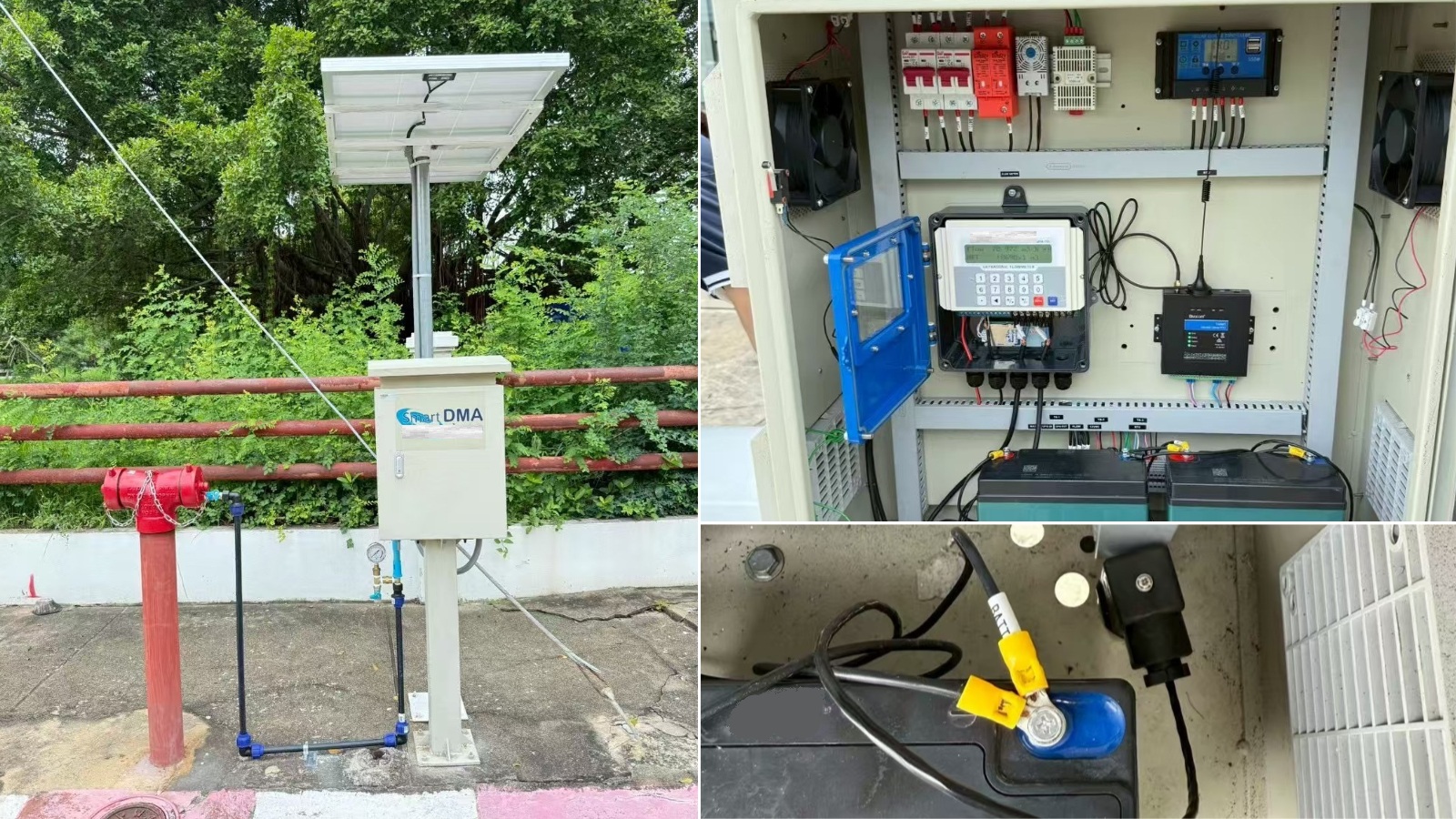
Project Background & Core Challenges
The utility operates widely dispersed, roadside DMA zones lacking fiber and municipal power. Exposed to tropical extremes (heat >40°C, high humidity, and frequent lightning), traditional SCADA and manual surveys were cost-prohibitive. The customer required a fire-hydrant bypass setup running on solar energy.
Core Customer Requirement
The utility required a lightweight, non‑intrusive setup – fire hydrant bypass sampling combined with solar off‑grid power and a rugged edge IoT device. That device had to feature local caching and breakpoint‑resume transmission to guarantee data continuity for MNF algorithms, ultra‑wide voltage tolerance and low power consumption to pair seamlessly with solar storage, and industrial‑grade wide‑temperature hardware to survive tropical outdoor environments – all while eliminating heavy cabling, reducing field visits, and delivering reliable minute‑level data for precise leak detection.
The Solution: Beyond “Just Data Collection”
To understand the deployment, we must examine the physical power and data flows.
Full on-site hardware bill: Solar PV panels, solar charge controller, battery bank, DC circuit breaker, lightning protection & environmental control assemblies, flow transducer, ultrasonic flow host, fire‑hydrant pressure‑sampling manifold, pressure transmitter, local mechanical pressure gauge, Bivocom TG501 Industrial Mini RTU.
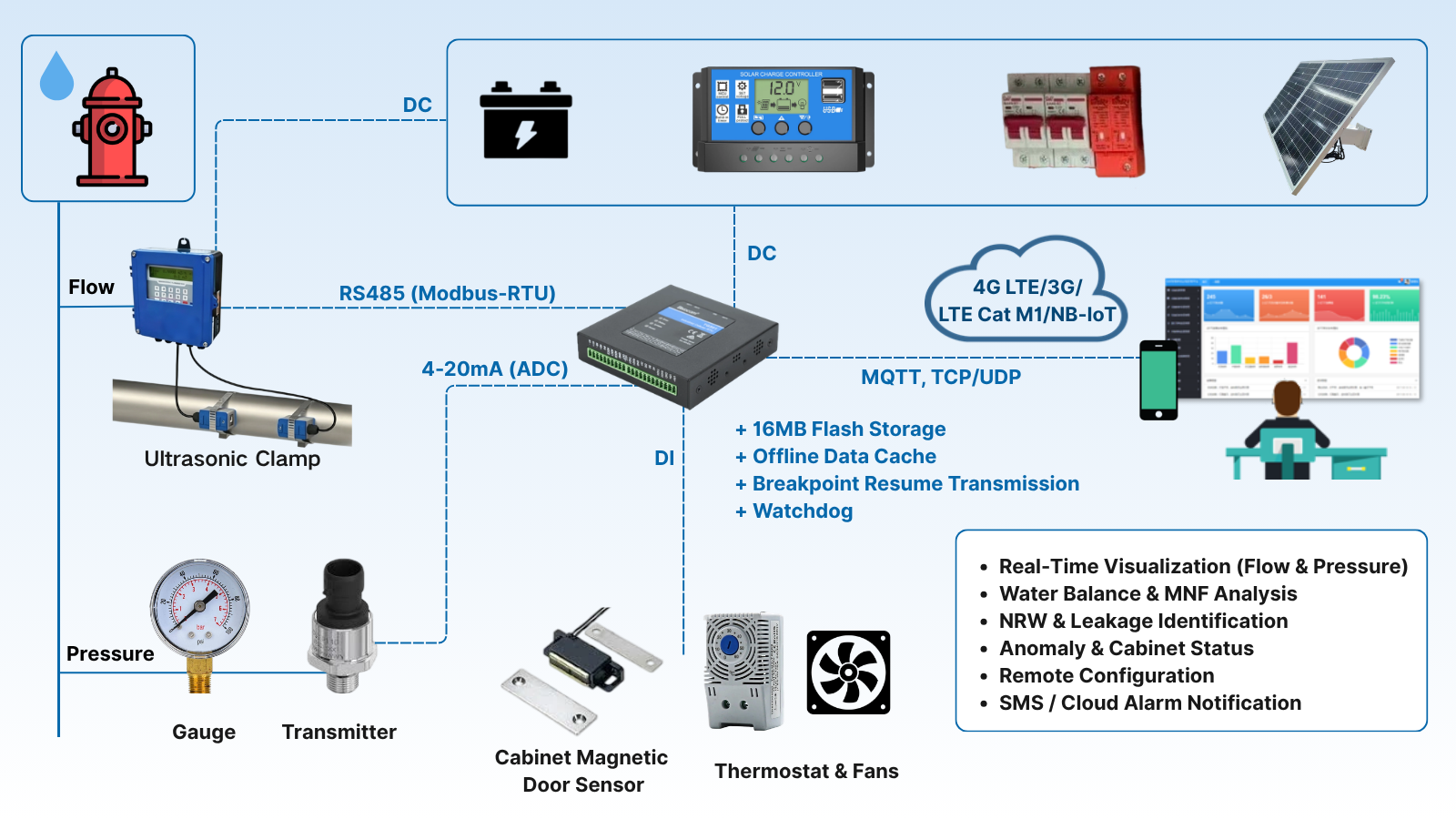
1. Sensing Layer (Field Sensors & Instruments)
- Ultrasonic flowmeter: Installed on the hydrant bypass sampling pipe. It adopts the acoustic time‑difference principle to calculate instantaneous flow rate, accumulated total volume and flow velocity. Measurement data is transmitted over standard Modbus‑RTU via RS485 interface.
- Pressure transmitter: Tee-mounted on the bypass pipe. Generates a 4–20 mA signal wired to the ADC port of the TG501 RTU. A local mechanical gauge is paralleled for on-site visual inspection, and an upstream pressure reducing valve protects the sensor.
- Environment & Security: A thermostatic controller triggers cabinet fans when temperatures exceed thresholds. A magnetic door sensor connects to the TG501’s DI for tamper monitoring.
- Solar & Power Supply: Fully off-grid, a solar PV array and charge controller charge batteries into a unified 24V DC bus to power all cabinet devices. Integrated SPD/MCB protect hardware from surges and faults, ensuring multi-day off-grid autonomy.
2. Network & Edge Transmission Layer
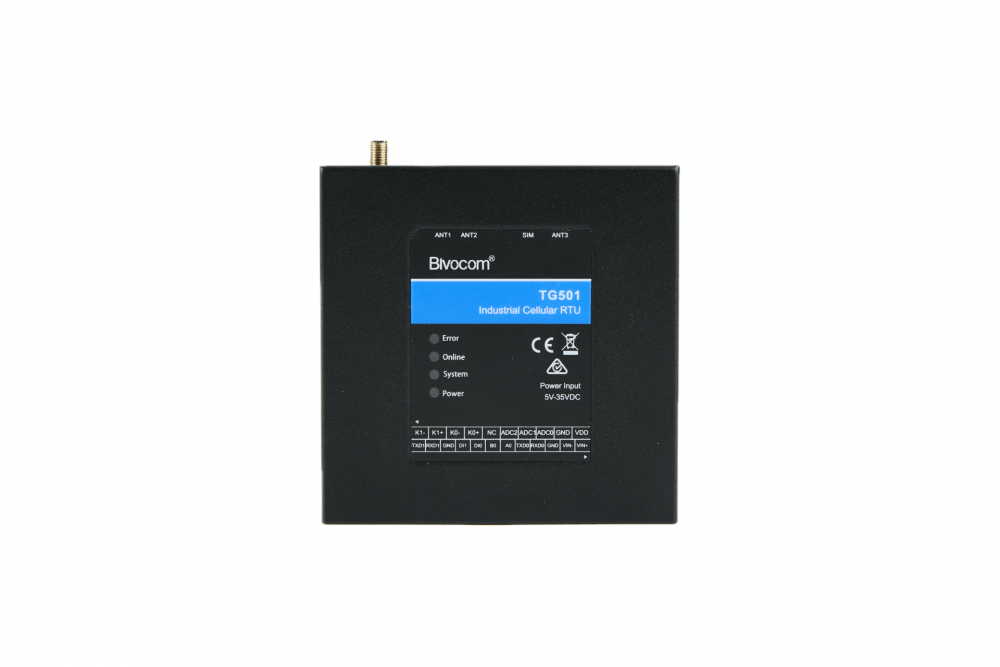
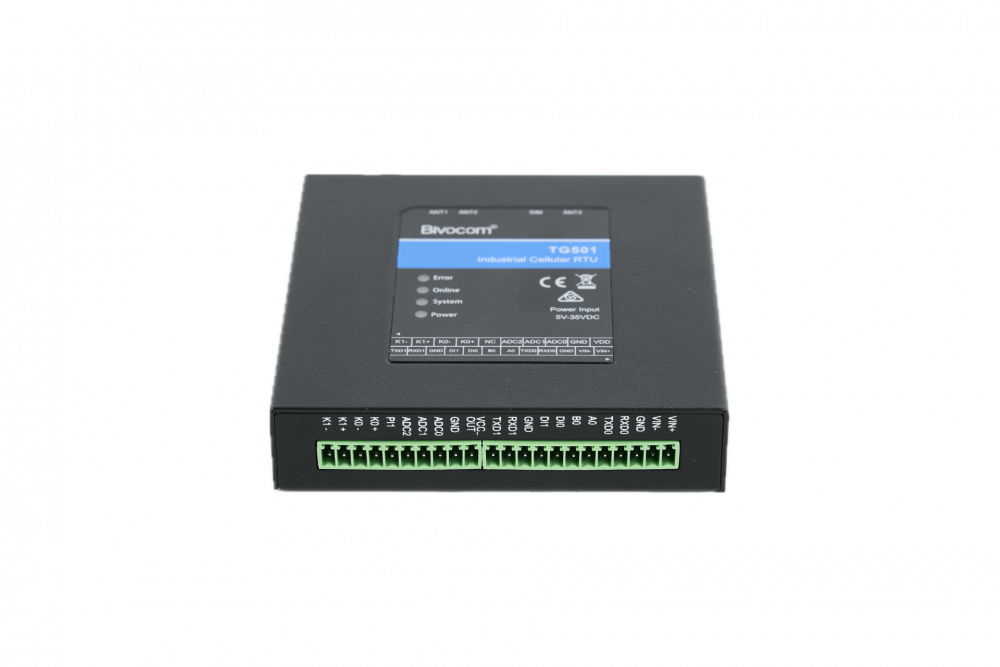
Bivocom TG501 Mini RTU serves as the centralized edge computing, data acquisition and wireless transmission core of the off-grid DMA station. Equipped with industrial-grade multi-I/O and multi-protocol capability. It unifies sensor data collection, local caching, protocol parsing, and cloud uplink in a single compact DIN-rail device.
The TG501 features a rich hardware interface suite, including 1 × RS485, 2 ×RS232, 3 ×16-bit ADC channels, 2 ×DI, and 2 ×DO. It supports multiple global cellular networks (4G LTE, 3G, LTE Cat M1, NB-IoT) and natively stacks essential industrial protocols like Modbus RTU/TCP, MQTT, and TCP/UDP. Furthermore, it is equipped with 16MB onboard flash storage for local data caching and a hardware watchdog for self-recovery.
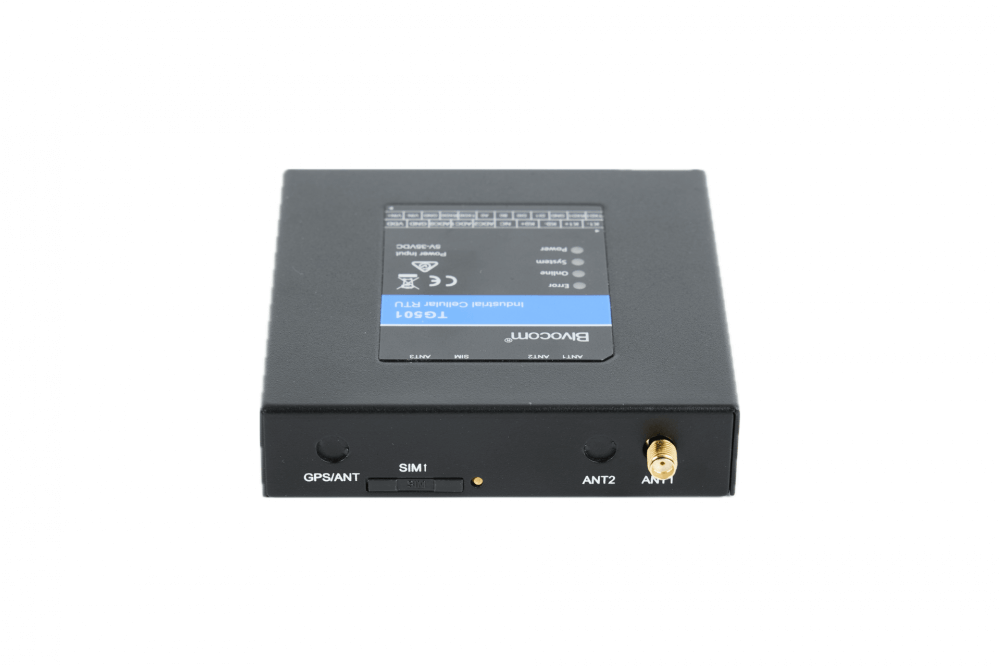
Field-Specific Role in This Project:
In this specific roadside deployment, the TG501 acts as the Modbus Master. It cyclically polls the Ultrasonic Flowmeter over the RS485 interface, while simultaneously reading the 4–20mA signal from the pressure transmitter via its ADC port and monitoring the cabinet door’s magnetic switch via its DI port.
To guarantee 100% data integrity for night-time leak analysis, the TG501 utilizes its local caching and breakpoint-resume transmission mechanisms. If the network drops, all time-stamped flow and pressure data is securely buffered on the 16MB flash. Once the signal returns, the TG501 automatically pushes the backlogged data to the cloud in chronological order, ensuring no data loss during critical low-flow periods. Additionally, its onboard logic can trigger direct SMS alarms to field engineers if the pressure threshold is breached or the cabinet is tampered with.
3. Cloud & Application
On the uplink side, the TG501 transmits the aggregated, time-stamped datasets to the utility’s central DMA management platform via its global 4G/LTE module, using MQTT or TCP/IP protocols. Once ingested, the cloud platform performs automated, heavy-lifting analytics. Key application functions include:
- Time-Series Visualization: Real-time dashboards displaying flow and pressure curves.
- Water Balance & Minimum Night Flow (MNF) Analysis: The system autonomously calculates low-flow periods to detect hidden pipe bursts.
- Anomaly Detection: Advanced threshold-based alarms enable proactive alerts for low pressure or sudden flow surges.
Measurable Project Outcomes
After commissioning these hydrant‑mounted DMA stations, the water utility achieved tangible operational improvements:
- Continuous minute‑granularity 24/7 monitoring replaces sporadic manual monthly readings, eliminating critical gaps in time‑series datasets
- Reliable MNF analysis enables accurate identification and localisation of underground micro‑leaks, driving measurable NRW water‑loss reduction
- Non‑destructive hydrant‑bypass installation combined with solar off‑grid power cuts civil‑construction scope and accelerates large‑scale roll‑out timelines
- Edge‑triggered alerting shifts operations from reactive leak repairs toward predictive pipe‑network asset management
About Bivocom
Bivocom designs and manufactures industrial-grade IoT edge gateways, cellular RTUs, and wireless routers purpose-built for critical infrastructure, energy, agriculture, and smart city applications. With a strong focus on rugged reliability and field adaptability, our comprehensive portfolio spans 4G/5G connectivity, GNSS positioning, LoRa, and IoT platforms.
- Open platform & ecosystem compatibility: Native support spans our device management platform, custom industry applications, and mainstream third-party IoT clouds, SCADA, and DCS systems.
- Full lifecycle support: End‑to‑end assistance from solution design and integration to field deployment and ongoing maintenance.
- OEM/ODMflexibility: Tailored hardware and firmware customization to meet specific project requirements without compromising reliability.
-on-Bivocom-TG465-IoT-Edge-AI-Gateway-with-Ubuntu-768x512.png "Install Ollama & Llama (LLM, large language model)) on Bivocom TG465 IoT Edge AI Gateway with Ubuntu")



Comment