Empower Solar Asset Management
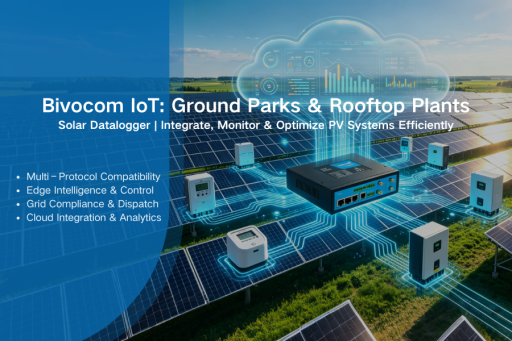
The solar industry is no longer just about panels and inverters. As solar parks and rooftop plants grow larger and more complex, a new question emerges: how do you monitor, control, and optimize hundreds of devices spread across miles of land or multiple factory rooftops? Traditional operation and fragmented monitoring systems restrict solar project profitability and grid compliance. Bivocom professional Solar IoT Datalogger becomes the core solution to unify the operation of all large-scale solar assets. This industrial-grade Solar IoT Datalogger bridges physical solar equipment and digital cloud platforms. It fixes long-standing operational pain points and realizes standardized, intelligent and low-cost solar asset management.
Two Core Solar Categories
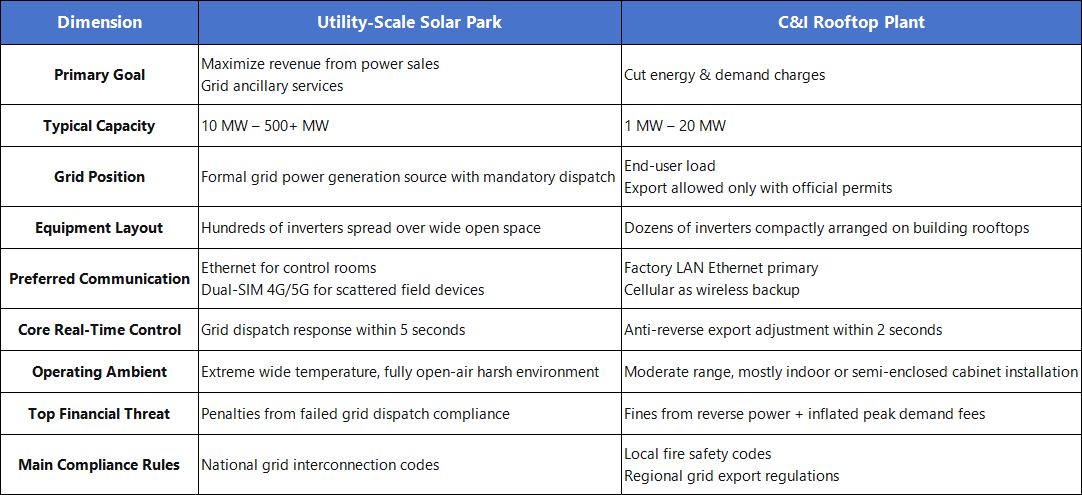
Utility‑scale ground solar parks and large commercial & industrial (C&I) rooftop plants form the backbone of today‘s distributed and centralized solar supply. Both generate clean power, but they operate under completely different business models, technical requirements, and pain points. Understanding these differences is the only way to design an IoT solution that works for both.
Utility-Scale Ground Solar Parks
A utility‑scale solar park is a large, ground‑mounted power generation facility. Typical capacities run from 10 MW to several hundred megawatts, covering hundreds of acres. It feeds electricity directly into the transmission grid under strict utility regulation. Core Goal: Maximize internal rate of return (IRR) over 20–25 years. Revenue comes from grid power sales, ancillary grid service subsidies, green certificates and carbon credits.
Core System Components & Power Flow
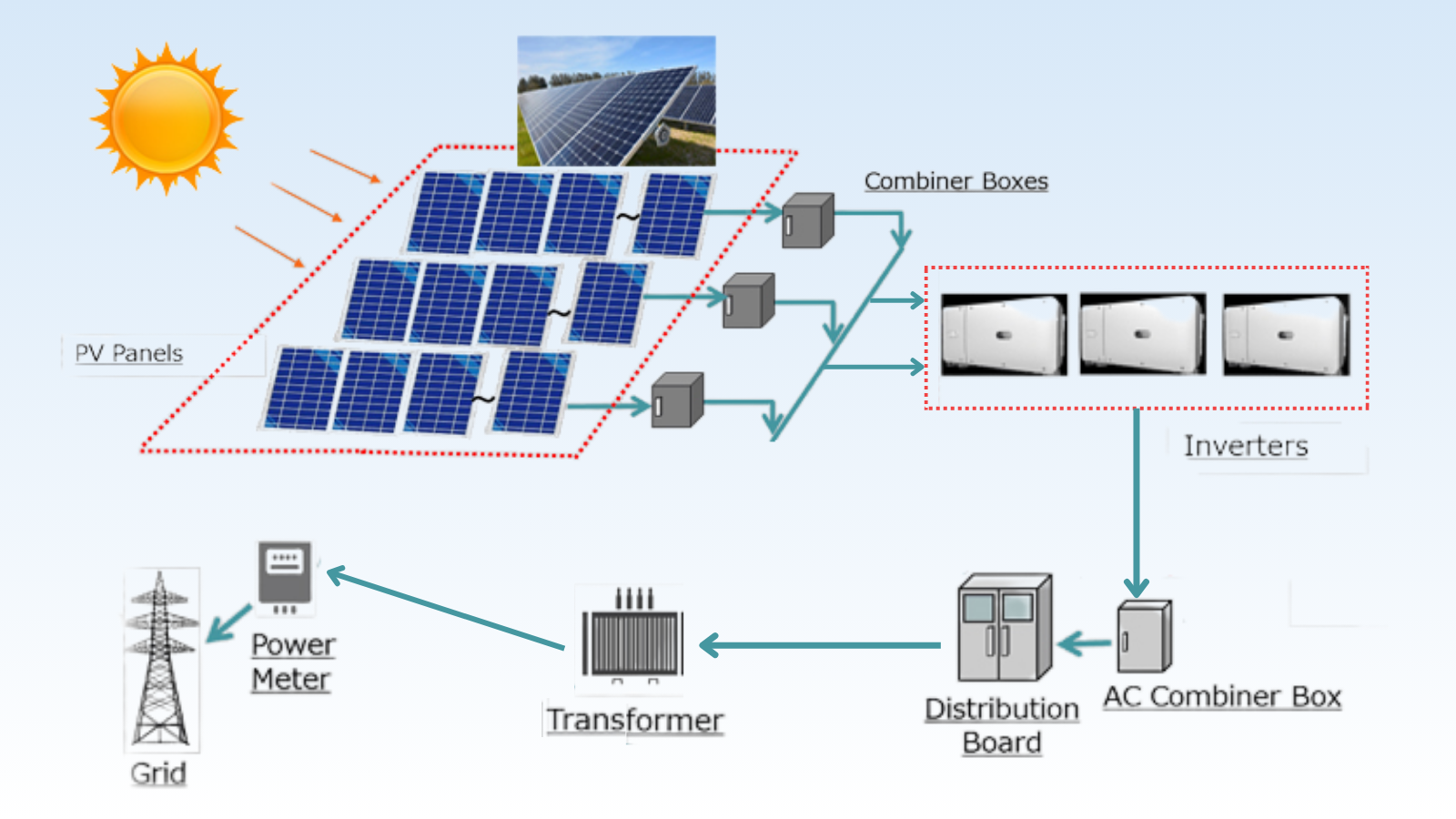
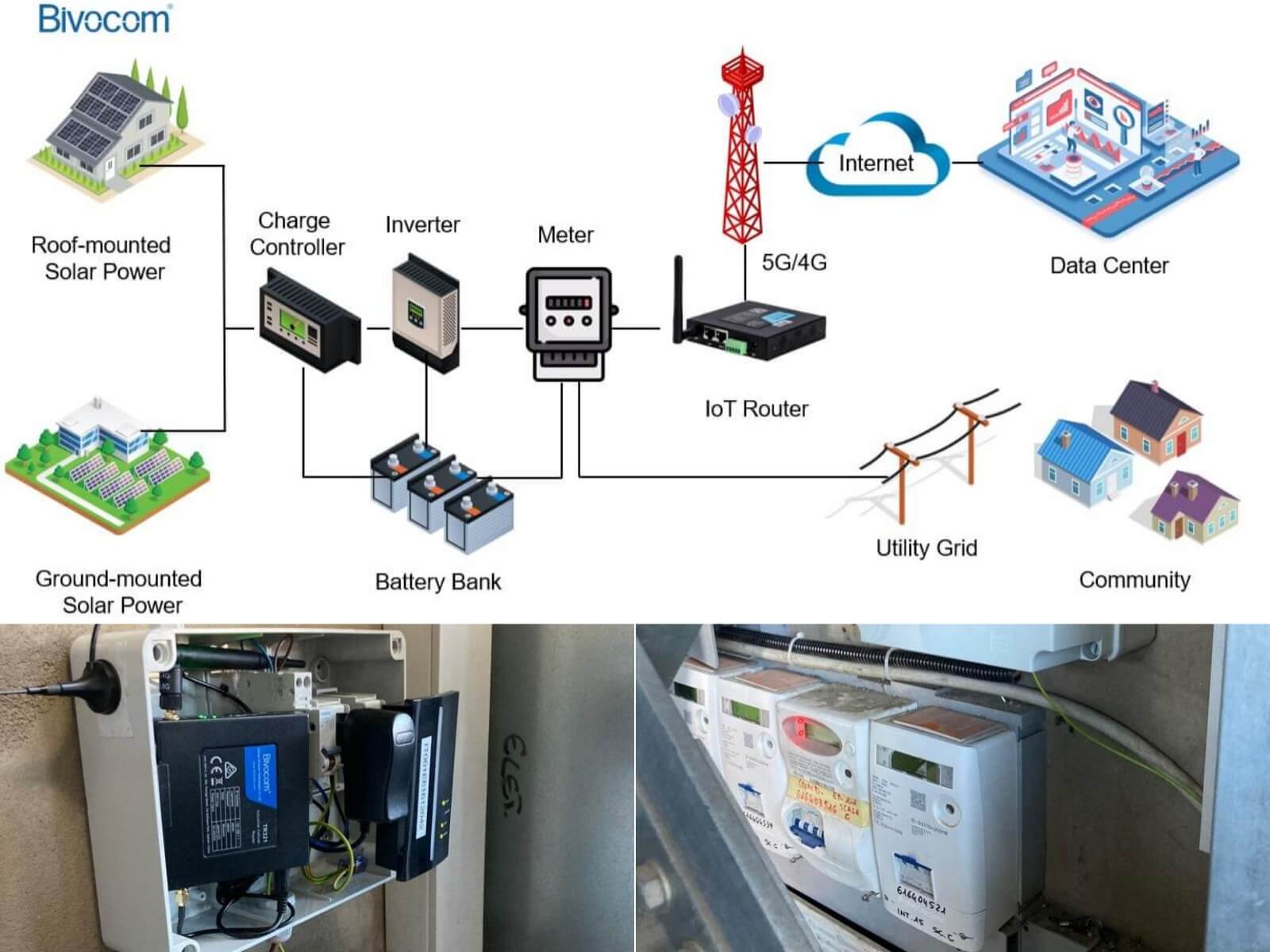
Key on-site hardware includes PV modules, string/central inverters, AC combiner cabinets, step-up transformers, high-voltage switchyards, revenue-grade bidirectional meters, on-site weather stations, optional solar trackers, battery energy storage (BESS), emergency diesel generators (DG) and multi-modal communication infrastructure.
Simplified power workflow: Sunlight converts to DC via PV modules → DC combiner boxes aggregate strings → inverters produce grid‑synchronized AC → AC combines in collection panels → step‑up transformers raise voltage → substation connects at PCC → electricity flows into public grid after protection & metering.
Key Operational Pain Points
- Scale and distribution: Hundreds of inverters spread over miles. Cabling is expensive, and cellular signal is often weak in remote areas.
- High O&M costs: Travel to a single fault can take half a day. Preventive maintenance relies on guesswork, and faults go unnoticed for weeks.
- Grid compliance (mandatory): Grid operators require real‑time telemetry (voltage, frequency, power) and remote dispatch commands (curtailment, PF adjustment). Failure or delay leads to fines—or disconnection.
- Harsh environment: Outdoor cabinets face -40°C to +70°C, dust, humidity, and lightning. Network outages are common, requiring local offline data caching to avoid billing record loss.
- Multi‑Asset Centralized Monitoring: Facilities integrate PV, battery storage and emergency diesel generation. Operators demand unified real‑time visibility across all equipment plus remote breaker switching capabilities.
C&I Rooftop Solar Plants
A C&I (commercial or industrial) rooftop plant is a distributed generation system installed on factory, warehouse, or shopping mall roofs. Typical capacity ranges from 1 MW to 20 MW. Unlike utility‑scale parks, its primary purpose is self‑consumption, while rules for surplus feed‑in are locally determined—ranging from full prohibition (zero‑export) to net metering or feed‑in tariffs. Core Goal: Reduce electricity bills—energy charges (per kWh) and demand charges (per kW of peak 15‑minute average load).
Note on Export Rules: Export regulations vary by country and region. Some utilities require zero‑export, others allow net metering, and a few offer feed‑in tariffs. Always verify local grid codes before deployment.
Core System Components & Power Flow
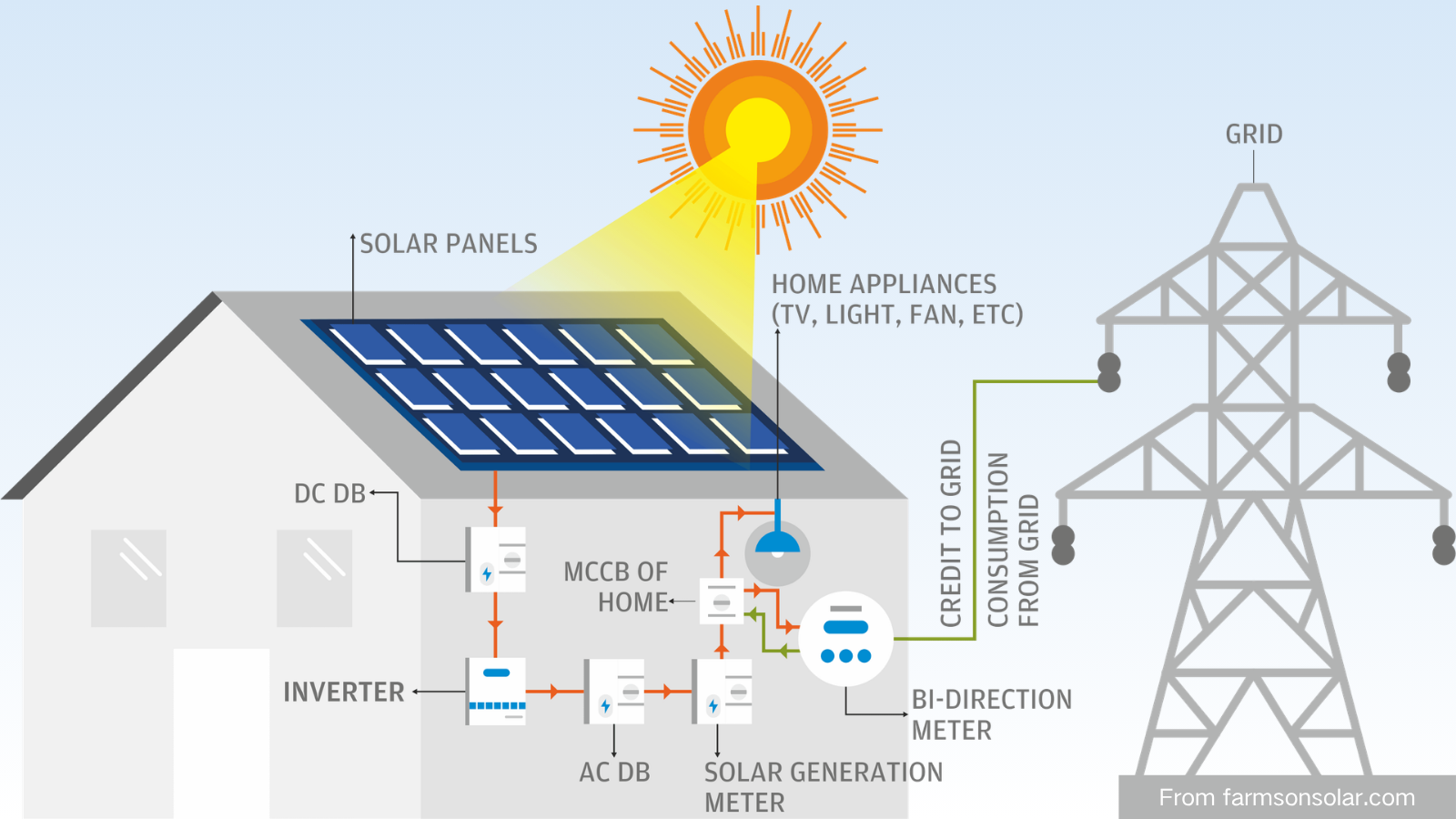
Main equipment covers rooftop PV panels, string inverters, AC combiner cabinets, bidirectional revenue meters, load measurement devices, rapid shutdown safety modules, optional BESS.
Simplified power workflow: PV generates DC → inverters convert to grid‑synchronized AC → on‑site loads consume power first. Excess may be exported (if allowed) or curtailed. The gateway continuously monitors the grid connection point; if export is disallowed, it signals inverters to limit output instantly, preventing reverse power flow.
Key Operational Pain Points
- Reverse power (anti‑export): Many regions forbid feeding power back without a permit. Unauthorized reverse power feed leads to steep utility penalties; real-time meter data analysis and instant inverter power limitation are mandatory.
- High Extra Utility Charges: Abrupt load spike the month’s demand charge, inductive motor equipment degrades system power factor to incur PF penalties, and seasonally varying time-of-use (TOU) rates complicate cost control.
- Power Coordination Demand: Most factories install DG for blackout emergencies, but legacy monitoring tools cannot realize automatic PV-storage-DG linkage to prevent costly production halts.
- Decentralized Wiring Trouble: Scattered PV arrays across separate rooftops lack pre-laid network cables; hardwired deployment drives up construction material and labor costs.
- Multi-System Integration Barriers: Operators need PV data synced with existing building management systems (BMS), while cross-factory asset owners require unified multi-site data aggregation for financial and carbon reporting.
Why IoT Is the Answer
Without IoT-enabled hardware, field devices operate as isolated standalone units, with trapped historical data and zero feasible remote control capability. An industrial solar IoT datalogger changes this completely. It sits between field equipment and the cloud, performing three essential roles:
- Collector: Reads data from inverters, meters, weather stations, and relays using protocols like Modbus, DNP3, or IEC 61850. Turns blind equipment into visible assets.
- Processor: Runs local logic, pre‑processes data, and executes control commands without waiting for the cloud. This enables real‑time responses and reduces data transmission costs.
- Transmitter: Sends clean, structured data via MQTT or REST API to any cloud platform—providing one interface for all upstream systems.
IoT Three Layers
To meet the needs of unified multi‑brand equipment access and long‑term data archiving, an industrial‑grade Solar IoT Datalogger acts as the core edge hardware, digitizing on‑site assets and enabling bidirectional remote control across the entire project lifecycle—from pre‑construction to asset retirement.
Layer 1: Perception—Digitalize all physical field devices
The Solar IoT Datalogger interconnects field equipment spanning PV modules, inverters, meters, weather stations, diesel generators, relays and energy storage BMS. Adopting devices’ native communication protocols including Modbus RTU/TCP, IEC 104 and DNP3, it collects real-time operational data (voltage, current, power, temperature and fault codes) and issues remote control orders for equipment startup, shutdown and parameter modification. This turns isolated equipment into traceable digital assets: most faults can be diagnosed remotely, mean time to repair drops dramatically, and O&M costs fall significantly—saving a medium‑to‑large plant hundreds of thousands of dollars each year.
Layer 2: Network—Multi-path bidirectional data tunnel
Multi-network modules support 4G/5G (dual‑SIM failover), Wi-Fi and Ethernet access at the same time. embedded protocol conversion translates field-side industrial protocols into standard MQTT or JSON-based REST API for upstream cloud upload. Enabling bidirectional communication: real-time data uplink plus downlink of remote commands including power curtailment, inverter restart and diesel generator switching. Local store‑and‑forward storage keeps data intact during temporary disconnections. For a remote solar park with weak signal, this ensures fast and reliable operation, separating compliance from daily penalties.
Layer 3: Edge & Cloud Intelligence—Act Locally, Manage Globally
About Bivocom
As grid compliance tightens and solar profit optimization becomes critical, intelligent monitoring is no longer optional for large‑scale projects. Throughout this article, we have used the term solar IoT datalogger to describe a device that collects, processes, and acts on field data. Bivocom, leading IoT and M2M solution provider. Our portfolio spans rugged hardware (GNSS/LoRa/5G routers, gateways, and RTUs), IoT platforms, and scenario-specific sensors. When deployed in solar environments, our gateways handle multi‑protocol access, real‑time control, edge intelligence, and cloud integration.
- Complete end‑to‑end service: Hardware, custom firmware, and IoT platform.
- Universal Multi-Protocol Compatibility: Native support for Modbus, OPC-UA, IEC 104 and DNP3, enabling plug-and-play access to mainstream global PV inverters and field devices.
- Edge Intelligence & Grid Compliance: Local edge computing supports grid dispatch response, anti-export control, automatic DG management, demand charge optimization, and offline data caching.
- Multi-Mode Redundant Networking: Flexible 4G/5G dual-SIM, Wi-Fi and Ethernet networking adapts to all complex on-site deployment environments.
- Open & Customizable Architecture: Linux with SDK (Python, C/C++, Node‑RED, Docker). Full OEM/ODM (custom firmware, OS, UI, branding).
- Cloud Integration: Mainstream third-party cloud platforms (eg. AWS IoT Core, ThingsBoard), or your own cloud.
- Global Service & Reliable Support: Backed by worldwide PV project experience, professional technical guidance, long-term warranty and rapid remote troubleshooting for global clients.
Ready to unify your solar asset management?
Contact us at [email protected]. Our professional team will customize cost-effective, profit-oriented digital solutions for your solar projects. For deeper technical details and case studies, stay tuned for our next article.
-on-Bivocom-TG465-IoT-Edge-AI-Gateway-with-Ubuntu-768x512.png "Install Ollama & Llama (LLM, large language model)) on Bivocom TG465 IoT Edge AI Gateway with Ubuntu")
Comment