Bale Press Monitoring Solution
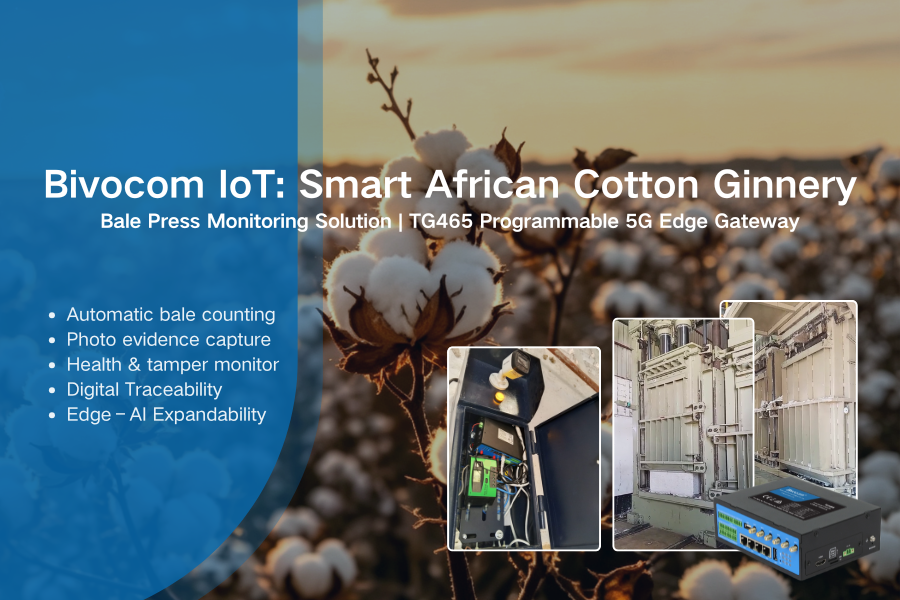
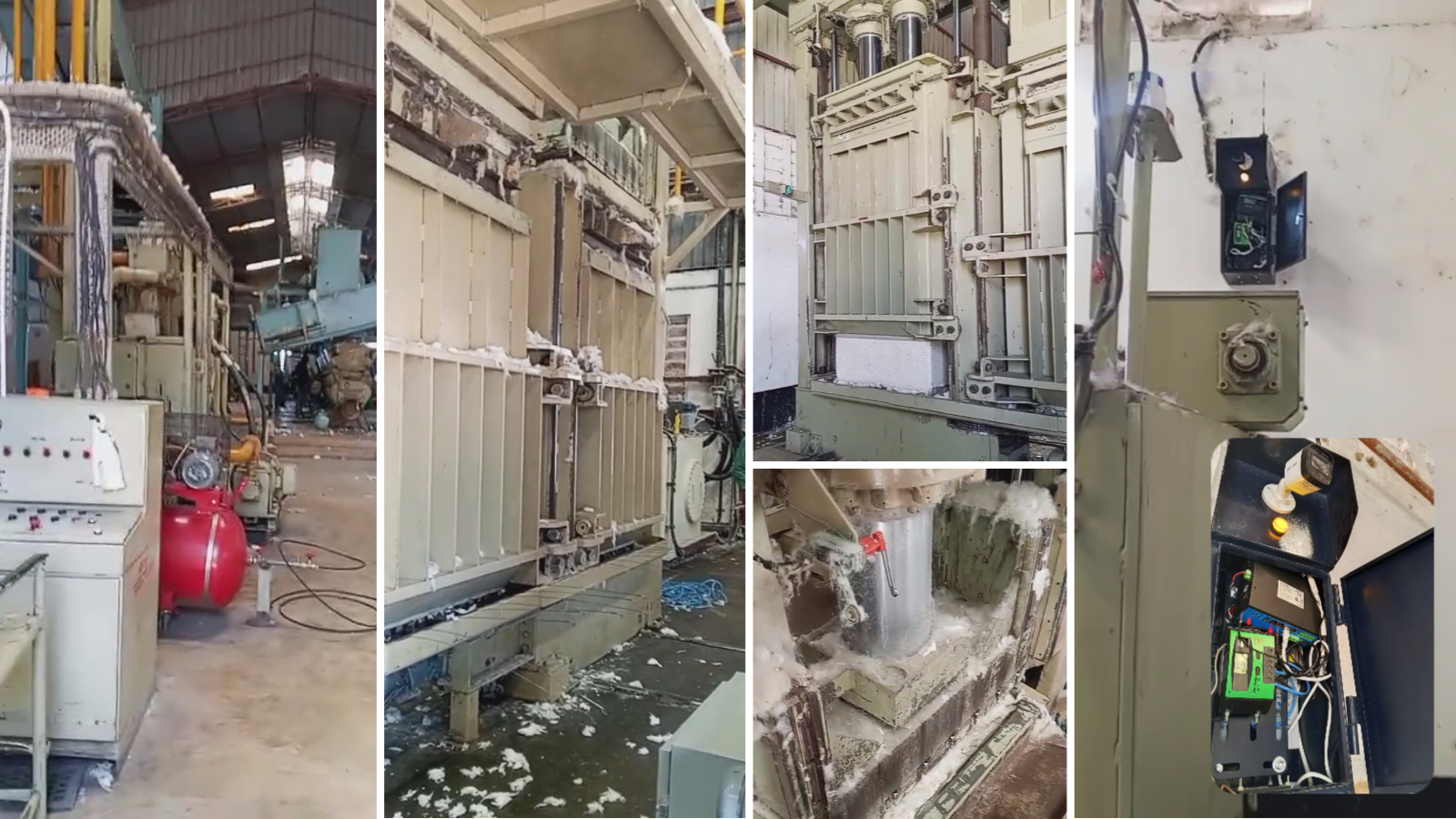
Cotton production underpins Africa’s economies. Yet most ginneries still rely on manual paper records—a system prone to counting errors, data tampering, and zero traceability. Without photographic proof and traceable documentation, facilities struggle to meet buyers’ requirements for origin verification and sustainability certifications, and cannot contest shipment rejections marked “poor wrapping”. A major East African integrator searched for an OEM-ready industrial device to upgrade on-site bale tracking. Bivocom deployed the TG465 programmable edge gateway as the core controller—an all-in-one solution delivering automatic counting, event-triggered snapshots, offline caching, and 4G transmission—enabling lightweight digital transformation without costly legacy press retrofits.
Market & Industry Background
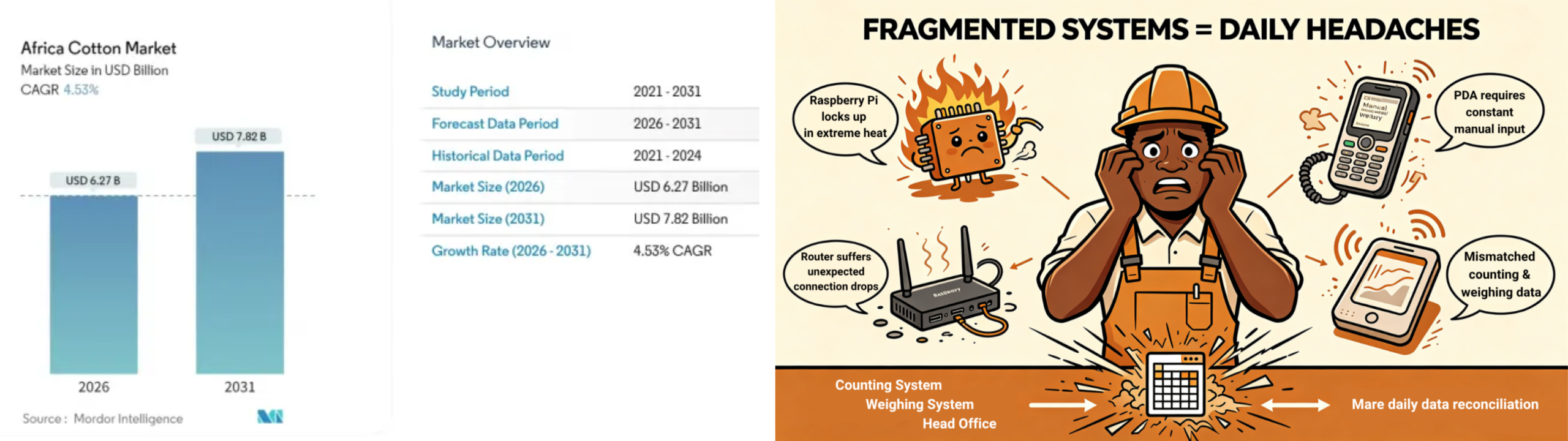
Africa accounts for roughly 10% of global cotton output, with the majority of lint exported to European and Asian textile manufacturers, sustaining millions of smallholder farmers across the value chain. Between 2022 and 2026, demand for industrial digitization within African ginneries has accelerated sharply, driven by certification standards such as Cotton Made in Africa (CmiA), trade frameworks like the AfCFTA, and mounting ESG compliance mandates that impose stringent traceability and verifiable proof‑of‑origin requirements. The Africa Cotton Market is valued at USD 6.27B (2026), forecast to grow at a 4.53% CAGR to 2031. Core Industry Challenges:
- Power & Connectivity: Grid electricity is inconsistent. Many facilities operate with off-grid solar and battery storage systems. Patchy network coverage across remote sites, with frequent and prolonged network dropouts.
- Harsh environment: Sustained temperatures above 45 °C combined with heavy cotton dust degrade consumer‑grade electronics and trigger frequent hardware failures.
- Limited Local Technical Support: On‑site maintenance resources are scarce. Operators favour compact, integrated low‑maintenance hardware over complex multi‑vendor stacks requiring specialist support.
Client’s Initial System Pain Point
Why Bivocom TG465
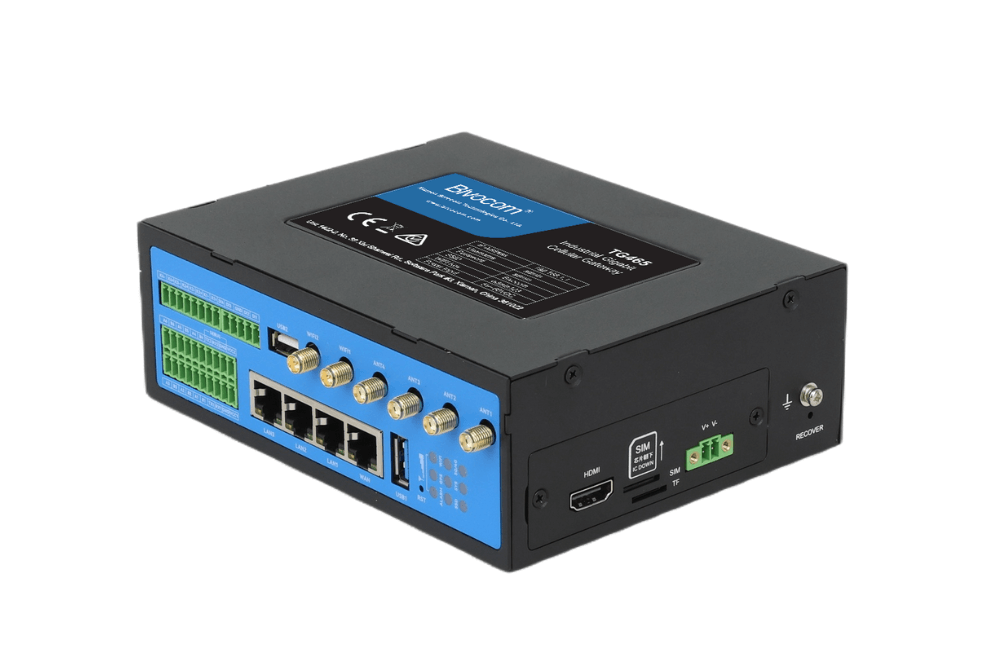
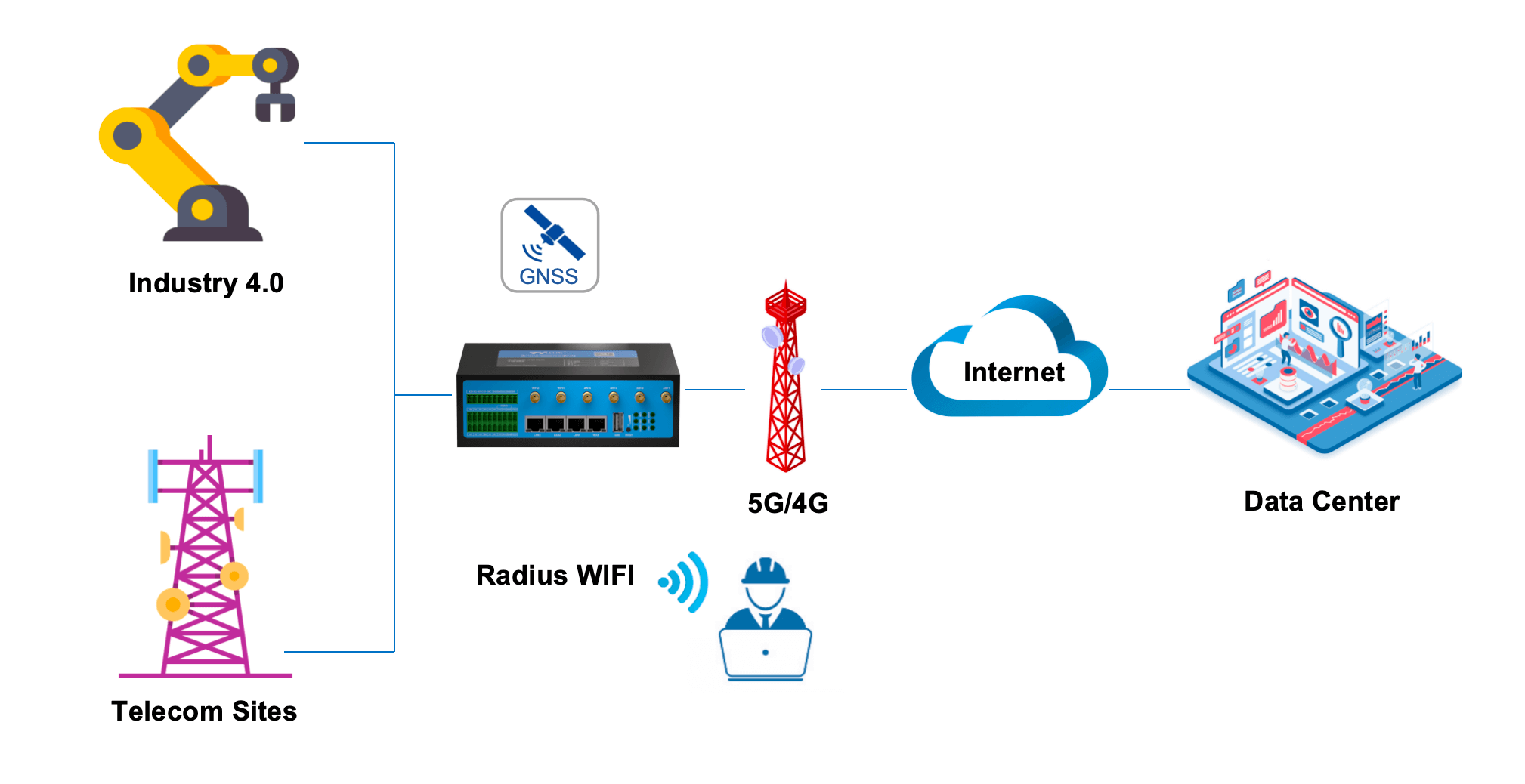
The TG465 is a powerful and intelligent next-generation IoT Gateway built-in with ARM CPU, GPU and NPU. It’s designed for mission-critical IoT applications that demand advanced connectivity, edge computing, enhanced security, AI and machine learning, and improved energy efficiency. It finds great utility in sectors such as industry 4.0, telecom sites, smart cities, smart grid, renewable energy, transportation, etc.
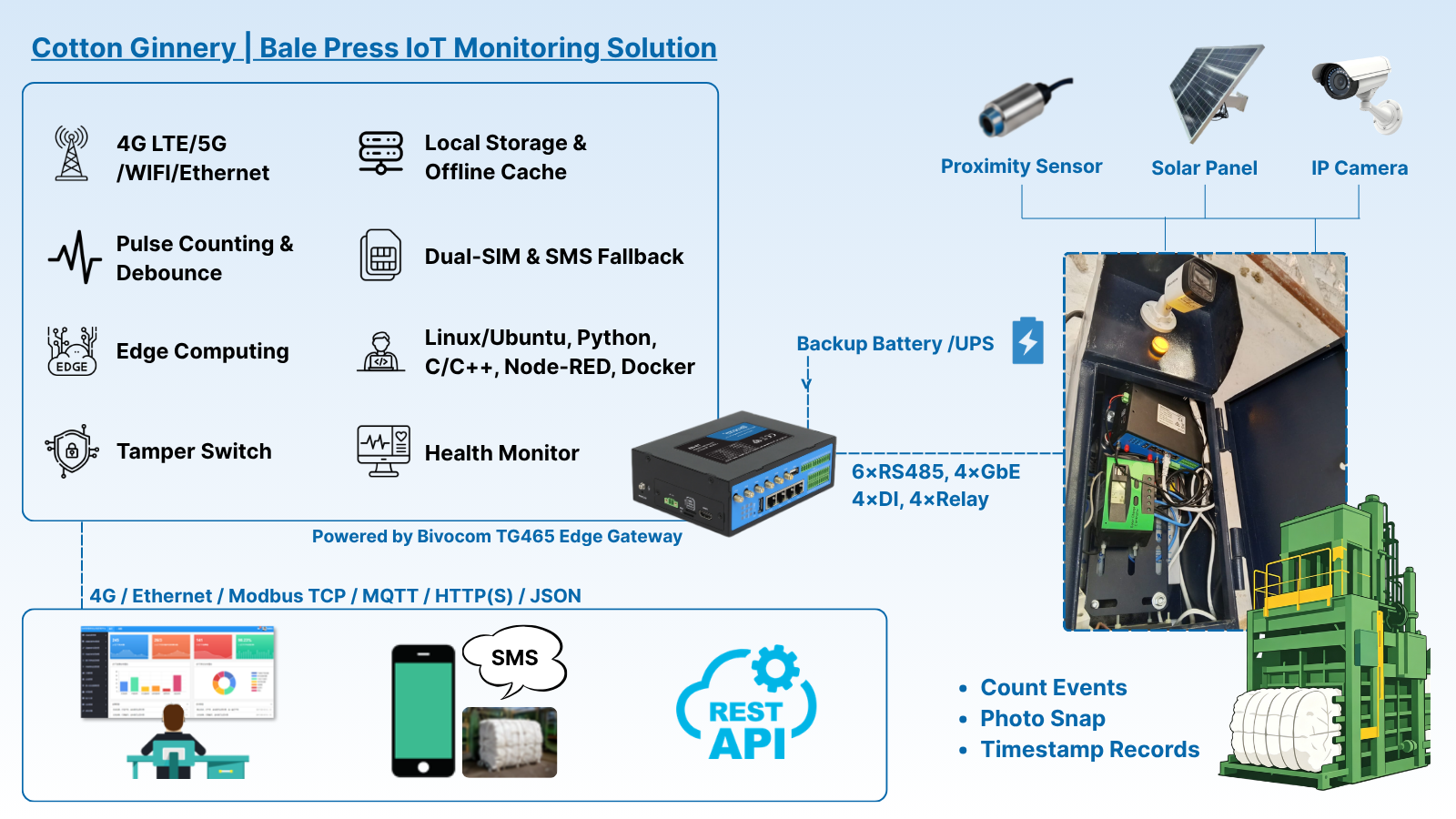
- Edge AI & Local Computing: Quad‑core CPU plus 1 TOPS NPU run counting logic, image processing and AI inference locally, removing cloud‑driven latency and enabling future intelligent feature upgrades.
- Rich Interfaces: 6×RS485, 4×DI, 4×Relay and 4×GbE ports support sensors, PLCs and cameras. Optimised DI debounce eliminates double‑counting errors.
- eMMC + NVMe SSD (up to 2TB): Provides extensive local storage for caching bale records and photos during outages, with automatic synchronization when connectivity resumes—ensuring zero data loss.
- Connectivity & Power Compatibility: 4G/5G with Dual‑SIM failover and 5–60 V wide‑voltage input suit off‑grid solar‑powered remote sites.
- Durability: IP30 metal housing with‑35 °C to +75 °C operating range withstands high heat and cotton dust.
- High Customisation & Integration: Open Linux/Ubuntu environment supports Python/C/C++/Docker for full payload customisation, tamper monitoring and seamless REST‑API backend integration.
- Health Management: Integrated watchdog and multi‑parameter status monitoring enable remote diagnostics and automated health reporting for predictive maintenance.

Beyond Counting: Edge AI & Architecture Expansion
Featuring 1 TOPS onboard NPU and GPU acceleration, the TG465 delivers low‑latency, cloud‑independent edge machine learning to support post‑launch intelligent enhancements:
- Automated quality inspection. Real‑time analysis of bale photographs to detect torn wrapping, irregular shapes, or other defects before bales leave the factory floor.
- Moisture content monitoring. Sensors via six RS485 ports track internal bale moisture during pressing—a critical export quality parameter.
- Predictive maintenance. AI models process vibration and temperature readings to anticipate machine faults and cut unplanned downtime.
- Safety visual detection. NPU‑based analysis detects smoke, flames, or excessive dust accumulation; thermal imaging identifies overheating equipment and electrical hot spots before ignition occurs, protecting personnel and assets.
Beyond cotton, the same architecture applies to cocoa fermentation, coffee cherry processing, grain auditing, and broader agricultural traceability. Featuring edge autonomy, offline resilience, AI inference, and industrial durability, the TG465 provides a scalable IoT template for modern, traceability‑centric agricultural digitization.
About Bivocom
Bivocom builds industrial‑grade IoT gateways and edge platforms for energy, agriculture, and critical infrastructure. Our portfolio spans GNSS/LoRa/5G routers, gateways, RTUs, IoT platforms, scenario-specific sensors, and OEM/ODM customization. Built on the TG465, our cotton ginnery IoT solution consolidates fragmented counting, weighing, storage, and communication hardware into a single DIN‑rail mountable industrial device. It replaces error‑prone manual logging with verifiable digital audit trails, simplifies ESG and origin compliance, and turns regulatory pressure into export advantage. Delivering immediate operational gains plus long‑term upgrade headroom, Bivocom provides a field‑proven, replicable digital‑transformation blueprint for global agricultural‑processing sites.
- Open platform & ecosystem compatibility: Native support spans our device management platform, custom industry applications, and mainstream third-party IoT clouds, SCADA, and DCS systems.
- Full lifecycle support: End‑to‑end assistance from solution design and integration to field deployment and ongoing maintenance.
- OEM/ODM flexibility: Tailored hardware and firmware customization to meet specific project requirements without compromising reliability.
-on-Bivocom-TG465-IoT-Edge-AI-Gateway-with-Ubuntu-768x512.png "Install Ollama & Llama (LLM, large language model)) on Bivocom TG465 IoT Edge AI Gateway with Ubuntu")



Comment