Cloud-Ready Fieldbus Data
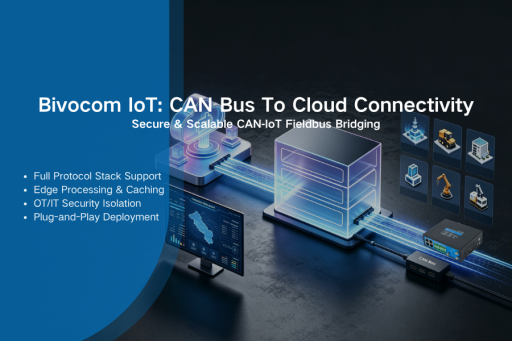
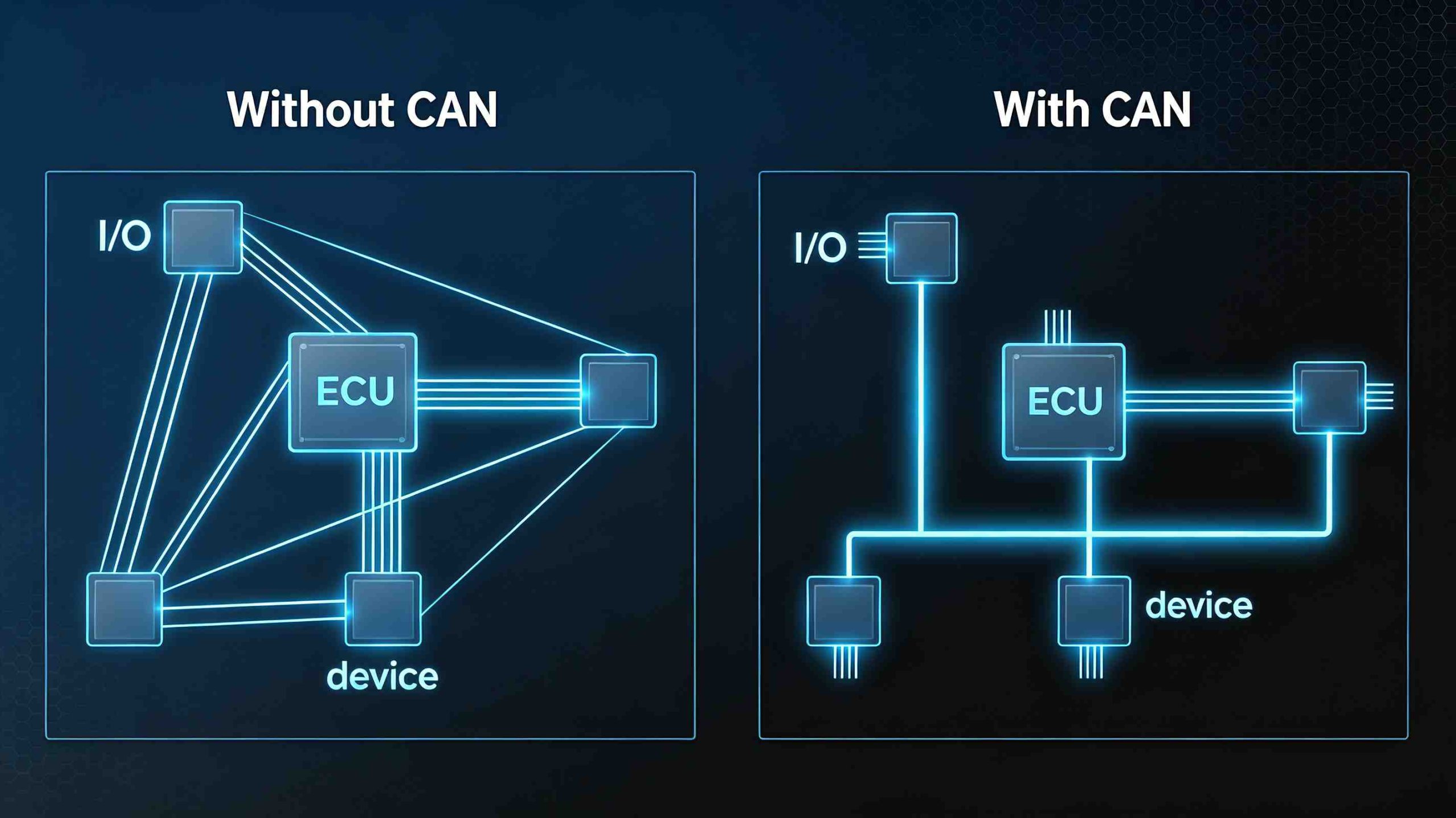
CAN, first developed to simplify wiring for automotive electronic control units, has evolved far beyond passenger vehicles. Today it powers communication in wind turbines, battery energy storage systems, construction machinery, AGVs, industrial robots and smart charging stations. Yet a core challenge emerges as these CAN-enabled assets move into IoT workflows: CAN was built for closed, deterministic on-device communication, not internet connectivity. Reliably and securely bridging CAN bus to cloud and enterprise IT systems is where Bivocom industrial IoT routers and gateways deliver critical value.
What is CAN?
CAN (Controller Area Network) is an ISO 11898 multi-master field bus designed for distributed real-time control. It defines both the physical layer (how signals travel across wires) and the data link layer (how data is framed, addressed, and error-checked). It enables peer-to-peer communication between field devices without a central host, and its differential signaling and non-destructive bitwise arbitration ensure high-priority fault messages are prioritised automatically, even in electrically noisy industrial environments.
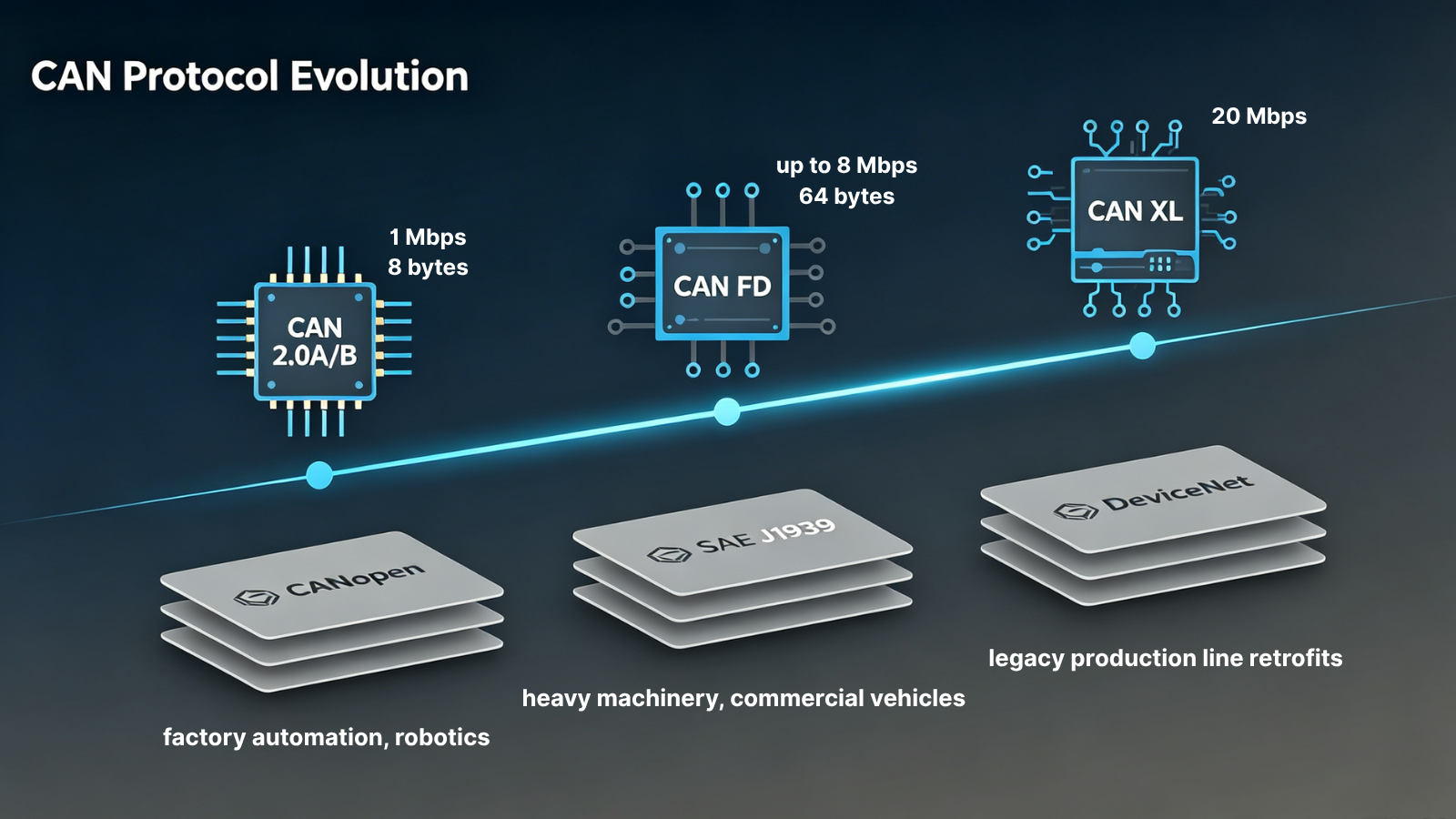
Three major variants exist: CAN 2.0A/B (classic, up to 1 Mbps), CAN FD (flexible data‑rate, up to 8 Mbps and 64 bytes per frame), and CAN XL (latest generation, approaching 20 Mbps). Above the base protocol, upper‑layer standards define data organisation and interpretation: CANopen serves factory automation, medical devices, and robotics; SAE J1939 is used in heavy machinery, commercial vehicles, generators, and marine applications; DeviceNet remains common in legacy production lines and PLC‑centric retrofits.
Why has CAN endured for nearly 40 years?
- Differential Signaling: CAN uses two wires (CAN_H and CAN_L) to transmit data. This design rejects electrical noise, making it highly reliable in industrial environments with heavy electromagnetic interference
- Priority Arbitration: When multiple devices transmit simultaneously, the message with the highest priority (lowest ID) wins — automatically, without data loss or collision delays
- Short-Frame Efficiency: Classic CAN carries up to 8 bytes of data per frame. This keeps transmission time extremely short, enabling microsecond-level real-time control.
- Robust Error Handling: Built-in CRC checks, acknowledgment, and error frames ensure data integrity
The Core Limitation: Raw CAN frames do not include native IP addressing, timestamps or built-in security controls. CAN bus cannot directly interface with Ethernet, cellular networks, cloud platforms, SCADA or MES systems — creating a clear OT/IT data barrier that IoT gateways resolve.
CAN + IoT: Bridging Fieldbus to Cloud
In an IoT architecture, CAN is the data source — not the communication backbone. Your engines, battery management systems, PLCs, and sensors use CAN to exchange real-time control signals. But CAN was never designed to connect to the cloud. The industrial IoT gateway solves this gap by ingesting CAN bus data, normalising it and forwarding usable information to IT systems.
Three Core Functions of a CAN-to-IoT Gateway
1. Protocol Translation – Making CAN “Speak Cloud”
Before processing, galvanic isolation protects the CAN port from ground offsets and surges. The gateway captures raw CAN frames and decodes binary payloads via DBC files into readable metrics (e.g., battery SOC, motor RPM, temperature, SAE J1939 DM1/DM2 fault codes). It completes the translation chain: CAN 2.0A/B, CAN FD, CANopen, or J1939 → Modbus TCP → MQTT/OPC UA → cloud or on‑premises platforms. This ensures that measurements from BMS, mining trucks, or welding robots arrive at SCADA or dashboards as structured, actionable data.
2. Edge Processing – Reducing Cloud Load
Not every CAN frame needs to go to the cloud. The gateway filters redundant messages, throttles high‑frequency traffic to save cellular costs, compresses data, and caches offline records with automatic retransmission when connectivity resumes. It also supports local logic and relay triggers for immediate on‑site responses, even without cloud connection. All records carry NTP/PTP timestamps for audit trails and fault diagnosis. This is critical because industrial CAN traffic is massive; sending raw frames to the cloud is costly, inefficient, and impractical.
3. Security Isolation – Protecting OT from IT
Often overlooked yet vital: CAN networks are physically accessible. A gateway enforcing unidirectional OT‑to‑IT data flow ensures that even if the cloud is compromised, attackers cannot reach the CAN field network. Hardware isolation, VPN tunnels (IPsec/OpenVPN), and encryption establish a robust security boundary.
CAN & IoT Protocols
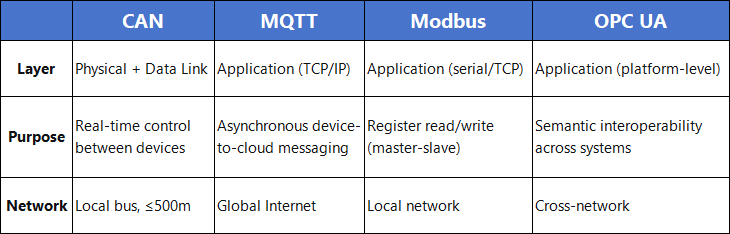
A common confusion we see in the industry is mixing up CAN with IoT protocols like MQTT, Modbus, or OPC UA. They are not alternatives—they are different layers in the same stack.
Real-World CAN IoT Use Cases
- Battery Energy Storage Systems (BESS): CAN connects the BMS to the PCS. The gateway reads voltage, current, temperature, and state of charge — pushing this data to the cloud for remote monitoring and predictive maintenance.
- Construction & Agricultural Machinery: J1939 is the standard for engine ECUs, transmissions, hydraulic systems, and GPS terminals. A gateway with J1939 support captures RPM, oil pressure, coolant temperature, fuel level, and fault codes — transforming a fleet of isolated machines into trackable, optimizable assets.
- EV Charging Stations: CAN handles communication between the charging controller, the electricity meter, and the vehicle’s BMS. The gateway parses CAN messages and forwards them to regulatory platforms using power industry protocols.
- AGVs & Mobile Robots: CANopen networks control drive systems and sensors. The gateway enables 5G low-latency backhaul, remote diagnostics, and real-time positioning.

About Bivocom
At Bivocom, we design industrial IoT gateways that make CAN-to-cloud connectivity simple, secure, and scalable. Our portfolio spans GNSS/LoRa/5G routers, gateways, RTUs, IoT platforms, scenario-specific sensors, and OEM/ODM customization. We provide proven edge processing, protocol translation, and reliable connectivity for energy storage, mobile assets, and smart manufacturing retrofits — reducing on-site engineering costs and accelerating digital asset deployment. And what sets Bivocom apart?
- Full Protocol Stack Support: CAN 2.0A/B, CAN FD, CANopen, and SAE J1939 — we speak all the major CAN “dialects”
- Edge Computing Built In: Filter, alert, compress, and cache CAN data at the edge — reduce cloud load and respond faster
- Non-Invasive Deployment: No need to replace existing CAN devices or rewire your site. Plug in, configure, and go.
- Industrial-Grade Reliability: Wide temperature operation (-35°C to +75°C), strong EMI resistance, hardware watchdog, and electrical isolation
Ready to bridge your CAN devices to the cloud?
To discuss your specific use case, reach our team at [email protected]. Whether you are a system integrator connecting a factory floor or a fleet operator monitoring hundreds of vehicles, Bivocom has a CAN IoT solution for your application.
-on-Bivocom-TG465-IoT-Edge-AI-Gateway-with-Ubuntu-768x512.png "Install Ollama & Llama (LLM, large language model)) on Bivocom TG465 IoT Edge AI Gateway with Ubuntu")
Comment