Unlock Building Intelligence
Commercial facilities often run HVAC, lighting, and access control from different vendors. Isolated protocols and separate management create operational and maintenance barriers. BACnet, the global standard for building automation, delivers reliable on-site control. IoT adds cloud connectivity and intelligent analytics. Together, they transform smart buildings from a concept into a driver of modern urban growth. At Bivocom, we build robust BACnet IoT gateways that seamlessly bridge legacy BACnet infrastructure to modern IoT ecosystems.
What Is BACnet?
BACnet (Building Automation and Control Networks) is an open, vendor-neutral communication protocol developed by ASHRAE. It was first issued as ANSI/ASHRAE Standard 135 in 1995, and officially recognized as an international ISO standard (ISO 16484-5) in 2003. The protocol addresses a long-standing industry challenge: isolated, closed building systems that lack cross-device communication capability. Currently deployed across more than 190 countries, BACnet unifies HVAC, lighting, security and energy management devices from all manufacturers.
BACnet brings three fundamental benefits to building automation:
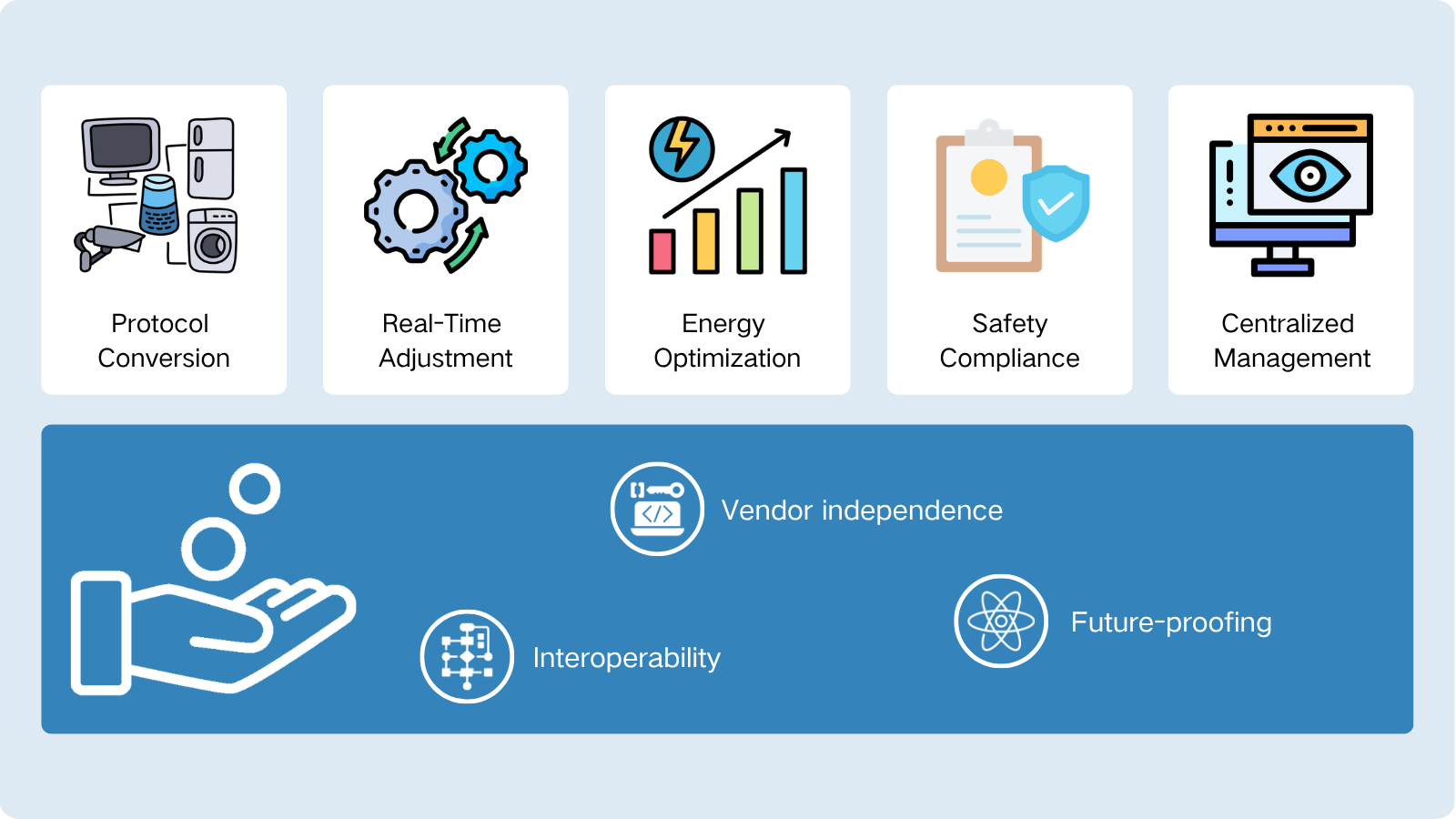
- Vendor independence: Building owners can mix products from any BACnet-certified manufacturer. There is no need to stick with a single vendor for upgrades or replacements.
- Interoperability: HVAC, lighting, fire safety, security, and energy metering systems can all work together. No custom integration is required.
- Future-proofing: BACnet has evolved continuously for over 30 years. New features like BACnet/SC (Secure Connect) keep the protocol current with modern security requirements.
For HVAC alone, the benefits are substantial. The systems can use 40–60% of a building‘s total energy. BACnet’s ability to share real-time occupancy, temperature, and equipment health data enables intelligent adjustments that cut waste significantly.
How BACnet Works?
BACnet is not a single cable or device—it’s a full communication protocol stack. Built on a simplified OSI-based layered architecture, BACnet balances performance and flexibility for diverse building environments. Four core layers work together to ensure stable data exchange.
 "How BACnet Works (Bivocom IoT Gateway)")
BACnet unifies the application and network layers across all implementations. At the physical and data link layers, the standard provides seven combinations. Among them, BACnet/IP over Ethernet and BACnet MS/TP over RS‑485 are the two most widely used in building automation. This layered, open design is what keeps BACnet simple, scalable, and interoperable — and exactly why it remains the global standard for building automation.
BACnet + IoT: Isolation → Connected Intelligence
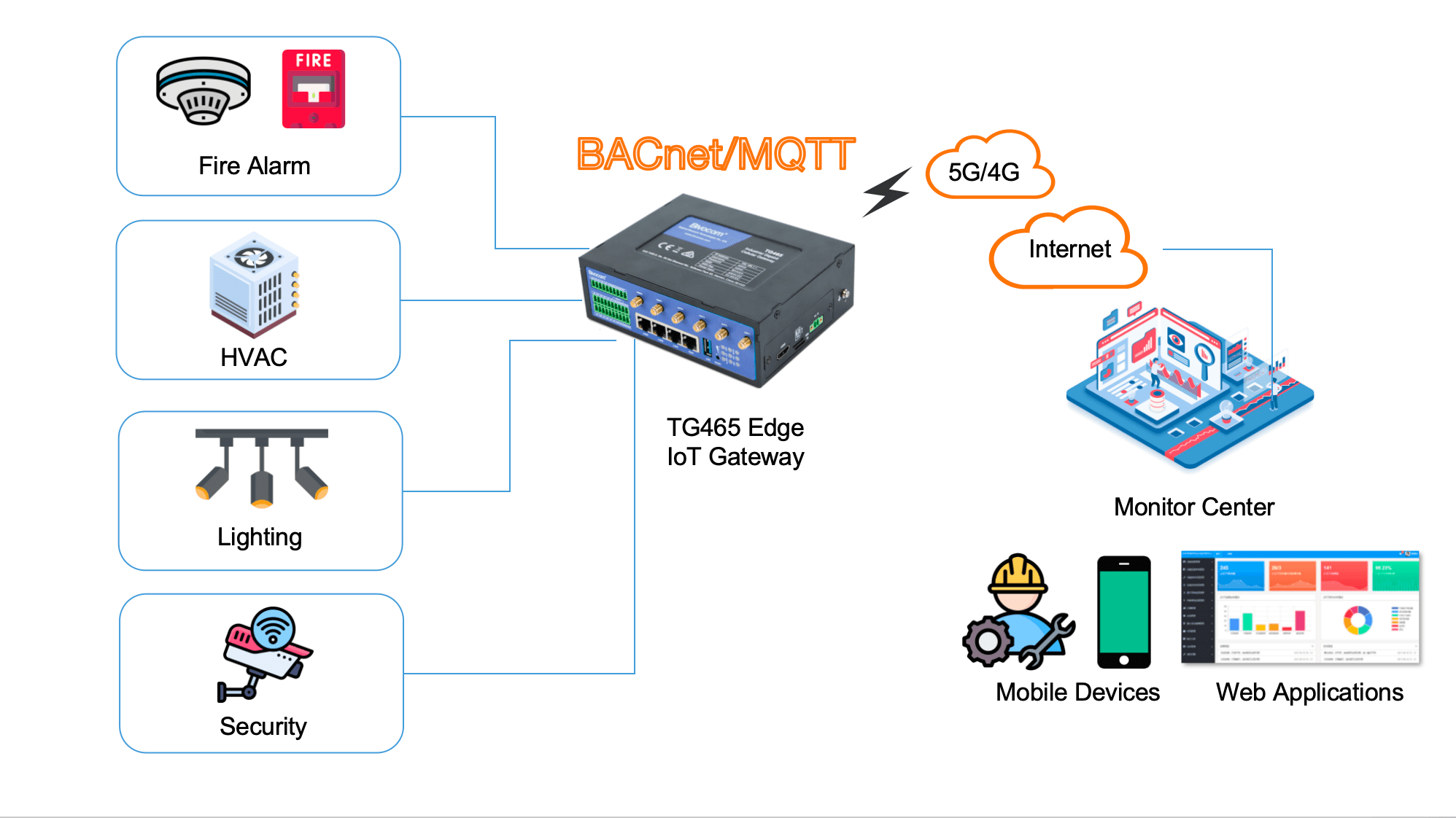
Traditional BACnet systems excel at on-site control but lack IoT’s key strengths. They are local, closed networks with no native cloud access. Operators cannot monitor remotely or analyze data for optimization. IoT changes this completely. Bivocom BACnet IoT gateways sit at the center of this transformation. An IoT gateway connects to BACnet devices on one side and to cloud platforms on the other. This simple architecture unlocks a new set of capabilities.
What happens inside the Bivocom BACnet IoT Gateways?
- Collect: The gateway acts as a BACnet client. It reads analog inputs, binary outputs, and other objects from BACnet/IP or BACnet MS/TP devices.
- Process: Edge computing scripts filter, aggregate, and transform data locally. Local logic can respond to events without waiting for the cloud.
- Translate: BACnet object models are mapped to modern IoT protocols like MQTT, HTTP, or REST APIs.
- Upload: Processed data is transmitted securely to cloud platforms like Azure IoT Hub, AWS IoT, or ThingsBoard.
- Control: Commands from the cloud or mobile apps travel back through the gateway to BACnet actuators.
What becomes possible with Bivocom’s IoT integration?
- Remote monitoring from anywhere. Facility managers can check equipment status, view alarms, and analyze trends from mobile devices or web dashboards, no matter where they are.
- Predictive maintenance. Cloud-based AI analyzes historical BACnet data to detect patterns that precede equipment failure. Maintenance happens before breakdowns, not after.
- Energy optimization at scale. Building portfolios can be analyzed together. Machine learning finds waste patterns across sites and recommends targeted improvements.
- Multi-site central management. A single cloud platform can monitor hundreds of buildings, each with its own BACnet network, all aggregated into unified dashboards.
- Integration with enterprise systems. BACnet data flows into ERP, CMMS, and business intelligence tools, bridging the gap between facilities and business operations.
The BACnet IoT gateway transforms a building from a data producer into a connected, intelligent asset. This is not a future vision—it is happening now in commercial offices, hospitals, schools, and industrial facilities around the world.
Why Bivocom for BACnet Deployments?
- Native BACnet Protocol Support: Bivocom gateways natively support both BACnet/IP and BACnet MS/TP data collection and can act as BACnet servers, making data available to BACnet clients like YABE or BMS workstations. This dual capability simplifies system integration.
- Multi-Protocol Conversion: Beyond BACnet, Bivocom gateways support Modbus RTU and Modbus TCP. Data from Modbus devices can be converted to BACnet objects seamlessly. This means legacy equipment does not need to be replaced.
- Built for Harsh Environments: Bivocom gateways use industrial-grade components with wide operating temperature ranges (-35°C to +75°C), metal enclosures, and IP30-IP68 protection options. They ensure reliable operation in mechanical rooms, rooftops, and other challenging locations.
- Edge Computing Power: Bivocom gateways run on OpenWrt or Ubuntu and support Python, C/C++, Node-RED, and Docker containers. Enable data filtering, alarm triggers, local control, and reduce cloud dependency.
- Reliable Connectivity: Dual SIM cards with automatic failover, 4G LTE and 5G global band support, and VPN (IPsec, OpenVPN, WireGuard) secure remote access.
- Seamless Cloud Integration: Publish BACnet data via MQTT/TLS to major clouds (AWS/Azure/ThingsBoard) or private brokers for secure, reliable transmission.
- Global Certifications: Bivocom devices carry certifications including FCC, CE, EN 18031, and more — supporting global deployment and regulatory compliance.
Looking Ahead: The Future of BACnet & IoT
- BACnet/SC: Its security and IT compatibility advantages make BACnet/SC the default for new installations within three years, especially in finance, healthcare, and government.
- Edge AI: IoT gateways will run edge ML models to learn normal HVAC patterns and detect anomalies without sending all data to the cloud—cutting bandwidth costs and speeding response.
- Digital twins: Platforms will pull BACnet data via IoT gateways to build real-time virtual models, simulating “what-if” scenarios before changes hit physical equipment.
- Industry standards converge: OPC UA, MQTT, and BACnet integration is progressing, with BACnet-to-OPC UA mapping standards already available. This convergence makes BACnet data easily accessible to industrial SCADA and enterprise IT.
- Sustainability: Global carbon targets pressure building owners to measure and reduce energy use. BACnet provides detailed operational data, while IoT delivers data to analytics platforms to identify energy-saving opportunities.
- IP to the edge:Falling Ethernet and Wi-Fi costs push IP connectivity deeper into field devices. Even simple sensors will speak BACnet/IP natively, reducing the need for MS/TP in new construction.
About Bivocom
BACnet has long been the reliable, open backbone of building automation, enabling interoperability across HVAC, lighting, security, and energy systems. But modern buildings need IoT connectivity. Bivocom‘s industrial-grade BACnet IoT gateways bridge legacy systems to digital infrastructure. With global project experience, robust hardware, native protocol support, and full-service capabilities, we transform traditional BACnet networks into smart, scalable IoT-ready systems—boosting efficiency, cutting energy use, and future-proofing investments.
- End-to-End Project Partnership: From pilot to global scale, we align our roadmap with yours.
- Global Field & Remote Support: On-site troubleshooting and remote diagnostics across 90+ countries.
- Custom Edge-to-Cloud Workflows: Tailored data flows and platform integrations for your building architecture.
- Empowerment Through Knowledge Transfer: Documentation, training, and best practices to make your team self-sufficient.
Ready to explore BACnet IoT gateway solutions?
What’s next? In our upcoming articles, we’ll show you more of the Bivocom–BACnet connection — including case studies, technical deep dives, and video walkthroughs. Contact us at [email protected]. Together, we build smarter, greener buildings.
-on-Bivocom-TG465-IoT-Edge-AI-Gateway-with-Ubuntu-768x512.png "Install Ollama & Llama (LLM, large language model)) on Bivocom TG465 IoT Edge AI Gateway with Ubuntu")
1 Comment