IoT-Enabled Building Intelligence
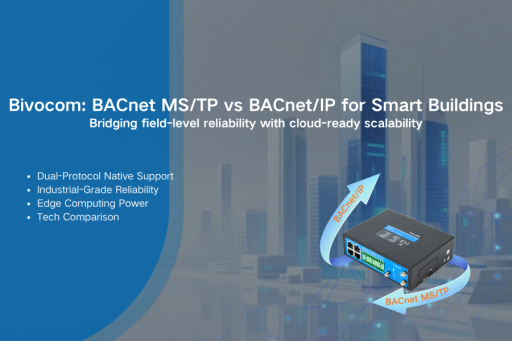
A BACnet & IoT Gateway is the backbone of smart building automation, bridging legacy field devices with modern cloud-connected systems. In our previous article, we explored how BACnet powers intelligent building control and why IoT integration is critical for future-ready facilities. Today, we break down the two core communication layers: BACnet MS/TP and BACnet/IP. Which one should you use? The answer isn’t always straightforward. Together, BACnet MS/TP and BACnet/IP account for over 95% of global building automation projects. They are not competitors—rather, they exist as complementary “carriers” of the same BACnet language. Bivocom, a leading global IoT solution provider with 11+ years of industrial expertise, delivers BACnet IoT solutions that unify both protocols for seamless smart building connectivity.
What Are BACnet MS/TP & BACnet/IP?
BACnet MS/TP (Master-Slave/Token-Passing) is the legacy field-level BACnet protocol, engineered for cost-effective short-range device communication. It runs on RS-485 serial wiring using a simple bus topology to connect sensors, DDC controllers, and HVAC equipment.
On an MS/TP network, devices pass a “token” around a logical ring—only the device holding the token can transmit. This avoids collisions and ensures predictable delays. MS/TP is slow (up to 115.2 kbps) but robust, reaching 1,200 meters per segment without repeaters. One RS‑485 trunk supports up to 128 devices. MS/TP excels at local field control, ideal for small buildings, retrofits, and electromagnetically noisy environments. However, it cannot connect directly to the cloud—that’s where a BACnet IoT gateway becomes essential.
BACnet/IP is the modern, network-native protocol built for high-speed, large-scale, and IoT-ready systems. It encapsulates BACnet data into UDP/IP packets over Ethernet, supporting star or tree topologies.
UDP enables automatic device discovery without a central controller. For devices across different IP subnets, BBMDs (BACnet Broadcast Management Devices) forward broadcast messages. Boasting speeds of 100 Mbps and above, BACnet/IP supports cross-subnet routing and direct cloud access. This makes it the natural choice for IoT integration in smart buildings. However, traditional BACnet/IP lacks built‑in encryption; secure it with VPNs or move to BACnet/SC.
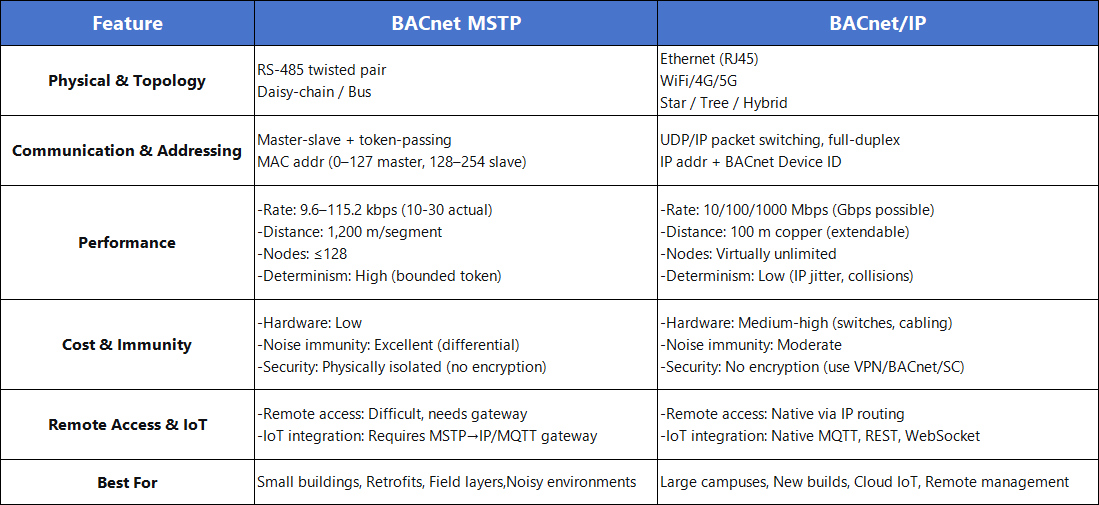
Quick technical snapshot
Advantages and Limitations – A Quick Recap
- MS/TP strengths: low hardware cost, strong EMI resistance, easy installation, stable for small networks, deterministic latency.
- MS/TP weaknesses: slow speed, limited scalability, no native IP/cloud support, single-point failure risk.
- IP strengths: native IoT/cloud connectivity, remote management, unlimited scalability, wireless support, high speed.
- IP weaknesses: higher infrastructure cost, risk of broadcast storms, steeper configuration learning curve, no built‑in encryption.
Hybrid Architecture
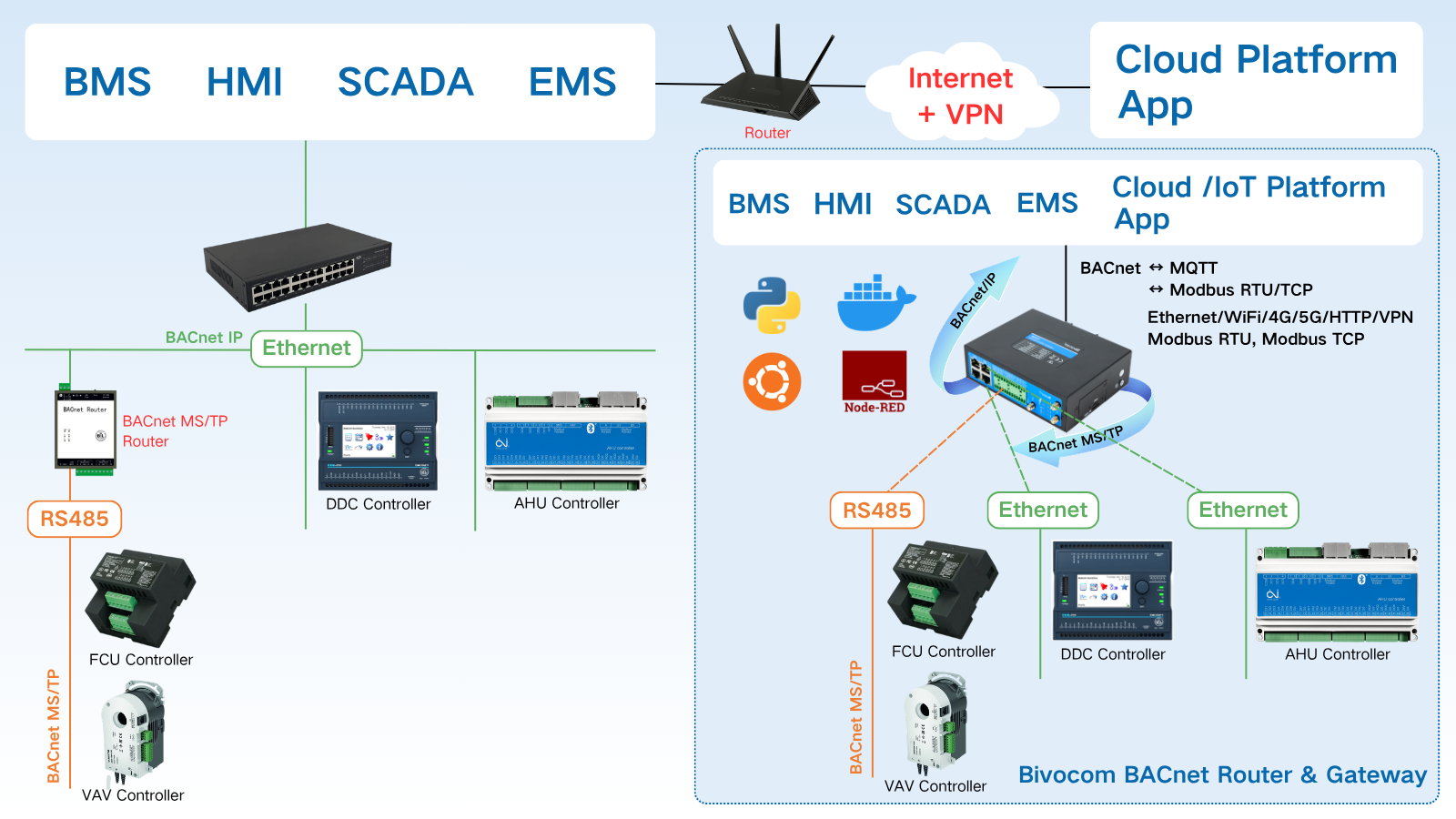
Why you need both, and an IoT gateway? Most real‑world building automation systems use both protocols. The field level (sensors, VAV boxes, fan coils) runs on MS/TP over RS‑485 – it is cheap, long‑distance, and noise‑immune. The backbone and management level runs on BACnet/IP – it is fast, scalable, and cloud‑ready.
To connect these two worlds, you need a BACnet IoT router/gateway. This device sits between the MS/TP trunk and the IP network. It collects data from MS/TP devices, translates it into BACnet/IP packets, and forwards it to building management servers (BMS) or cloud platforms. The gateway also handles the reverse direction: sending commands from the cloud down to field devices.
Key Capabilities of Bivocom’s BACnet IoT Devices
- Dual-Protocol Native Support: Simultaneous BACnet MS/TP (RS-485) and BACnet/IP (Ethernet) interfaces
- Bidirectional Protocol Conversion: MS/TP ↔ BACnet/IP seamless translation
- Multi-Protocol Interoperability: Modbus RTU/TCP ↔ BACnet conversion for mixed industrial/building systems
- IoT Cloud Enablement: Native MQTT/HTTP forwarding, edge caching, and offline data buffering
- Industrial-Grade Reliability: Wide-temperature operation, EMI shielding, 100% factory testing
- Remote Management: OTA updates, real-time monitoring, and diagnostic tools
Bivocom’s BACnet IoT gateway eliminates protocol silos. It lets you keep existing MS/TP devices while adding BACnet/IP scalability and IoT cloud connectivity—protecting your investment and future-proofing your building system.
About Bivocom
When you compare BACnet MS/TP vs BACnet/IP, remember that it is not a war. It is a design decision. Use MS/TP at the field level for low cost, long distance, and noise immunity. Use IP for speed, scalability, and cloud connectivity. In most projects, you will need both – and a BACnet IoT gateway from Bivocom is the simplest way to unify them.
- Hybrid Architecture Design: End-to-end network planning for field-backbone-cloud connectivity.
- Deployment Support: Step-by-step gateway setup and protocol debugging.
- Pre-shipment testing: Every unit is fully tested in our lab before delivery.
For tailored smart building IoT solutions or technical support, contact us at [email protected]. In our next article, we share a step-by-step configuration guide for the Bivocom TG452, covering BACnet MS/TP and BACnet/IP data collection, device simulation, Modbus conversion, and cloud transmission.
-on-Bivocom-TG465-IoT-Edge-AI-Gateway-with-Ubuntu-768x512.png "Install Ollama & Llama (LLM, large language model)) on Bivocom TG465 IoT Edge AI Gateway with Ubuntu")


Comment