How to Choose the Right Device
In our previous article, we covered modems and routers. But what happens when your site has dozens of devices speaking different protocols—Modbus RTU, BACnet, DNP3, IEC, and OPC UA all in one cabinet. That‘s where gateways and RTUs come in. They’re smarter, more capable—and more complex. This guide breaks down what each does, when to use which, and how they work together.
What Is a Gateway?
A gateway acts as a bridge connecting legacy field devices to cloud platforms. It translates diverse protocols and supports lightweight edge computing. Rather than simply forwarding raw data, it interprets, reformats and locally processes information before transmission. Think of a gateway as a multilingual translator: it supports Modbus RTU, Modbus TCP, MQTT, OPC UA, HTTP and other industry protocols simultaneously. On the southbound side, it links sensors, meters, PLCs and legacy equipment; on the northbound side, it communicates with modern cloud IoT systems.
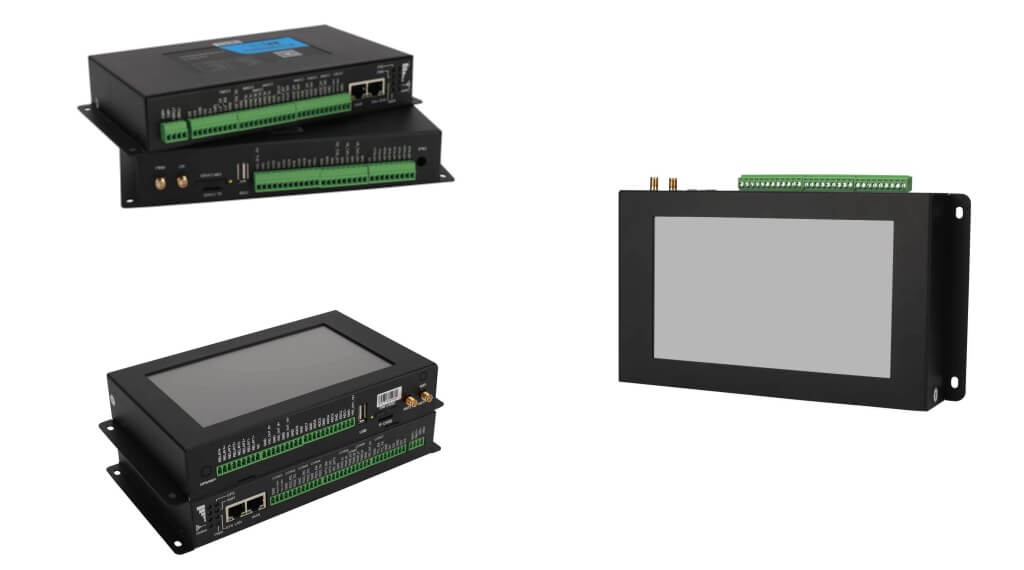
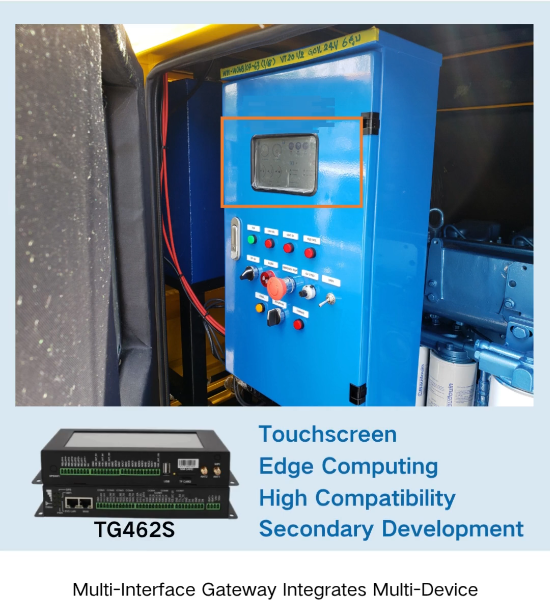
The Bivocom TG462/TG462S is a high-performance industrial edge gateway. Capable of local data acquisition, processing and caching with store-and-forward functionality, it seamlessly connects various legacy field hardware and transmits data via cellular networks. Flexible secondary development and OEM/ODM customization are supported. The TG462S variant integrates a 7-inch HD touchscreen for on-site operation and troubleshooting. Suitable applications include water/wastewater treatment, oil & gas, industrial automation, smart cities and environmental monitoring. Key specifications:
- CPU: 32‑bit ARM Cortex‑A7 @ 528MHz
- OpenWrt-based Linux/Ubuntu; programmable via C/C++, Python, LUA, Node-RED and SDK
- Storage & Memory: 256MB DDR3, up to 1GB flash; Micro SD slot (max 32GB)
- Network Interfaces: 2× RJ45 (10/100 Mbps, software configurable WAN/LAN)
- Cellular: LTE CAT 6 / CAT4, 1× SIM slot, 2× 50Ω SMA antenna ports, Wi‑Fi*, GPS*
- Serial & I/O: 4× RS232, 3× RS485, 4× DI, 8-channel 12-bit ADC (4–20mA / 0–5V), 4× Relay outputs, 5× sensor power outputs (12V/9V/5V), and auxiliary ports (I2C, TTL, USB)
- Protocols: Modbus RTU/TCP, MQTT, Transparent transmission, SNMP, OSPF, IEC, VPN suite (IPsec/PPTP/L2TP/GRE/OpenVPN)
- Management Methods: Web UI, CLI, SMS, Cloud DMP platform
Real World Scenario: Smart River Monitoring and Flood Alert System
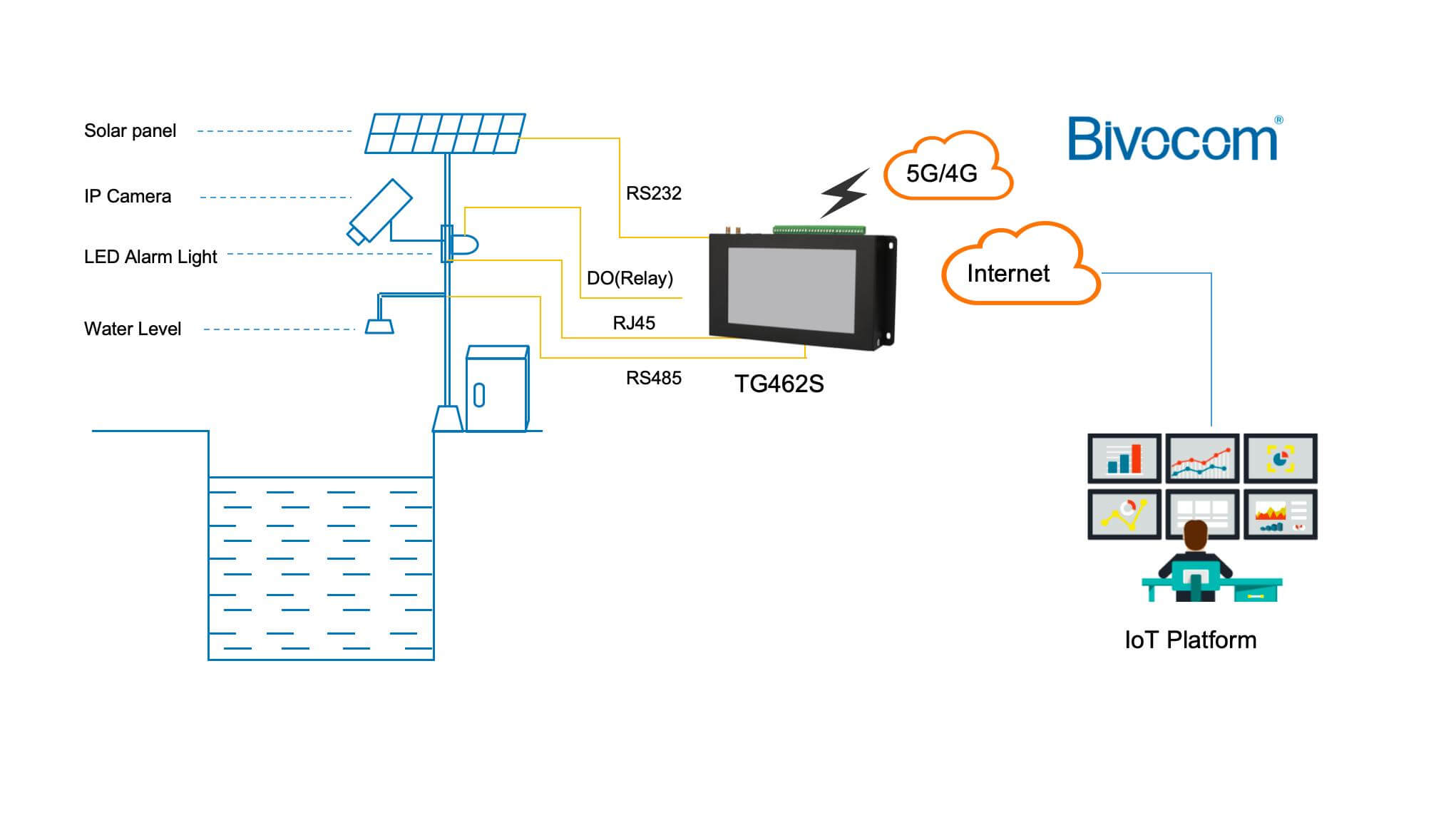
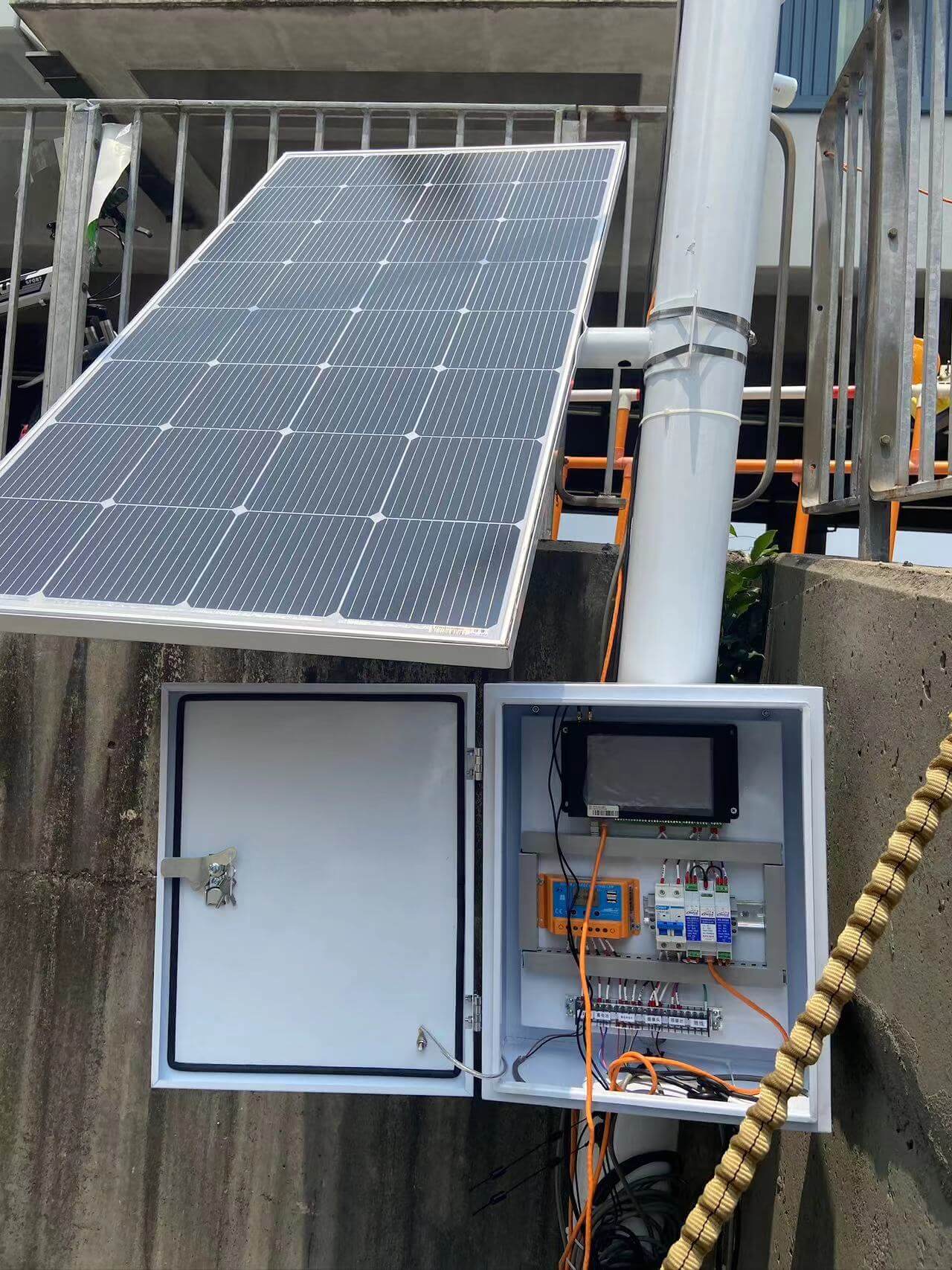
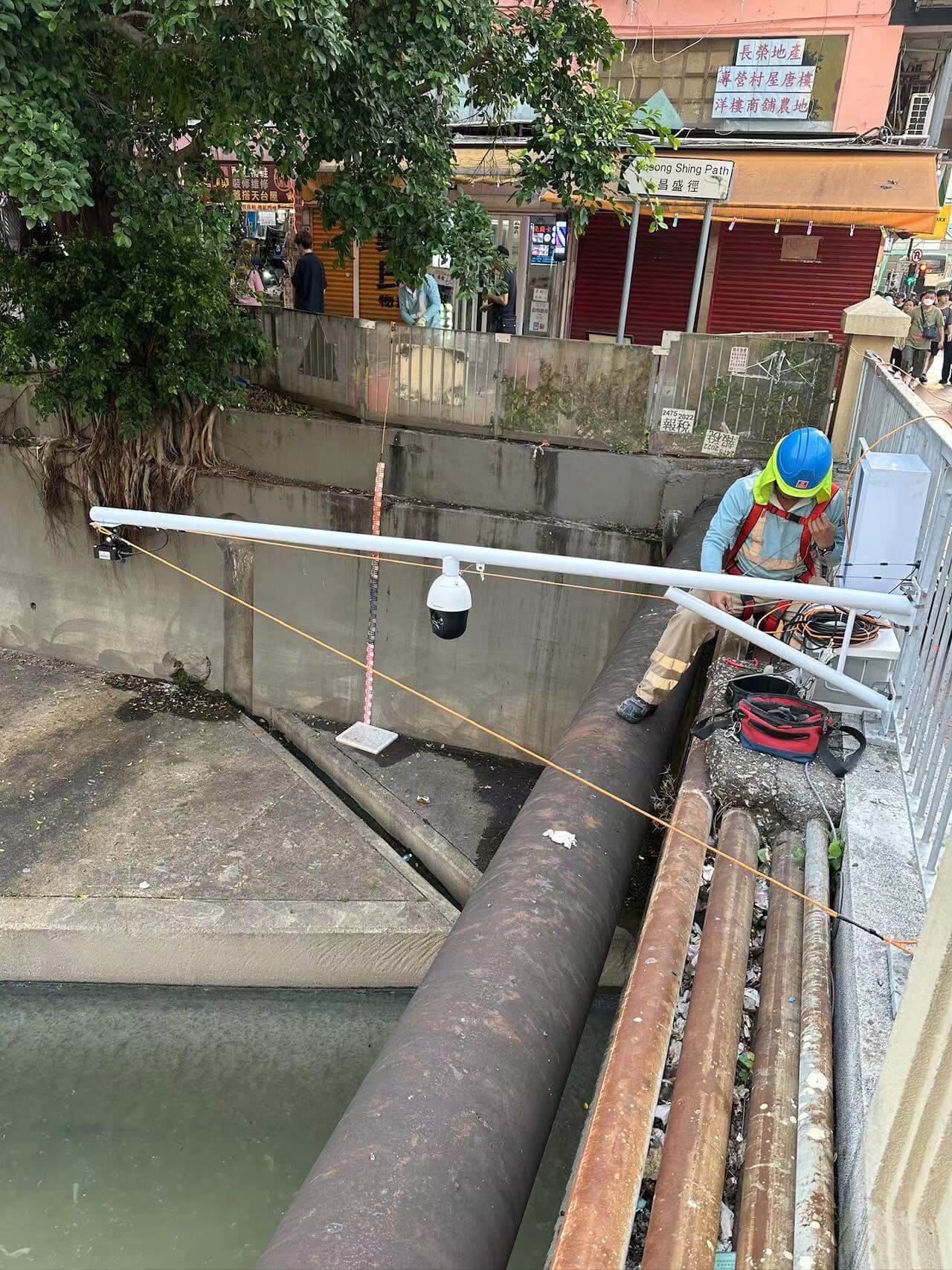
A Asian city deployed a smart river monitoring system to track water levels and rainfall across its complex network, mitigating flood risks. Radar level sensor, solar panel, rain gauge, and IP camera—each speaking different protocols—are installed at key locations. A traditional router or modem couldn’t handle the mixed interfaces, multiple protocols, or edge processing. The TG462S industrial gateway connects to all devices via RS485, Ethernet, and analog inputs, aggregates data, translates Modbus to MQTT, applies local threshold alerts, and transmits processed data to the cloud over 4G. Its 7‑inch touchscreen enables on‑site monitoring and maintenance without a laptop. The result: unified real‑time visibility across river networks, enabling proactive flood response and improved public safety.
When to Choose a Gateway
- Your field devices use different protocols (Modbus, BACnet, DNP3, etc.) that need translation to cloud‑friendly formats like MQTT.
- You need local edge computing—data filtering, aggregation, or analytics at the source.
- You need to integrate legacy serial equipment into a modern IoT architecture.
What is a Cellular RTU?
While modems, routers, and gateways are about moving data, an RTU (Remote Terminal Unit) is about controlling things and making decisions—even when the network is down. It gains wide adoption in water conservancy, energy and environmental SCADA systems. Think of an RTU as a local brain with hands and feet:
- Digital Inputs (DI) to read switch states (door open or closed, pump running or stopped)
- Analog Inputs (ADC) to read sensor values (water level, pressure, temperature, flow rate)
- Relay outputs to control equipment (start pumps, open valves, trigger alarms)
- Local logic—it can make decisions without waiting for instructions from the cloud
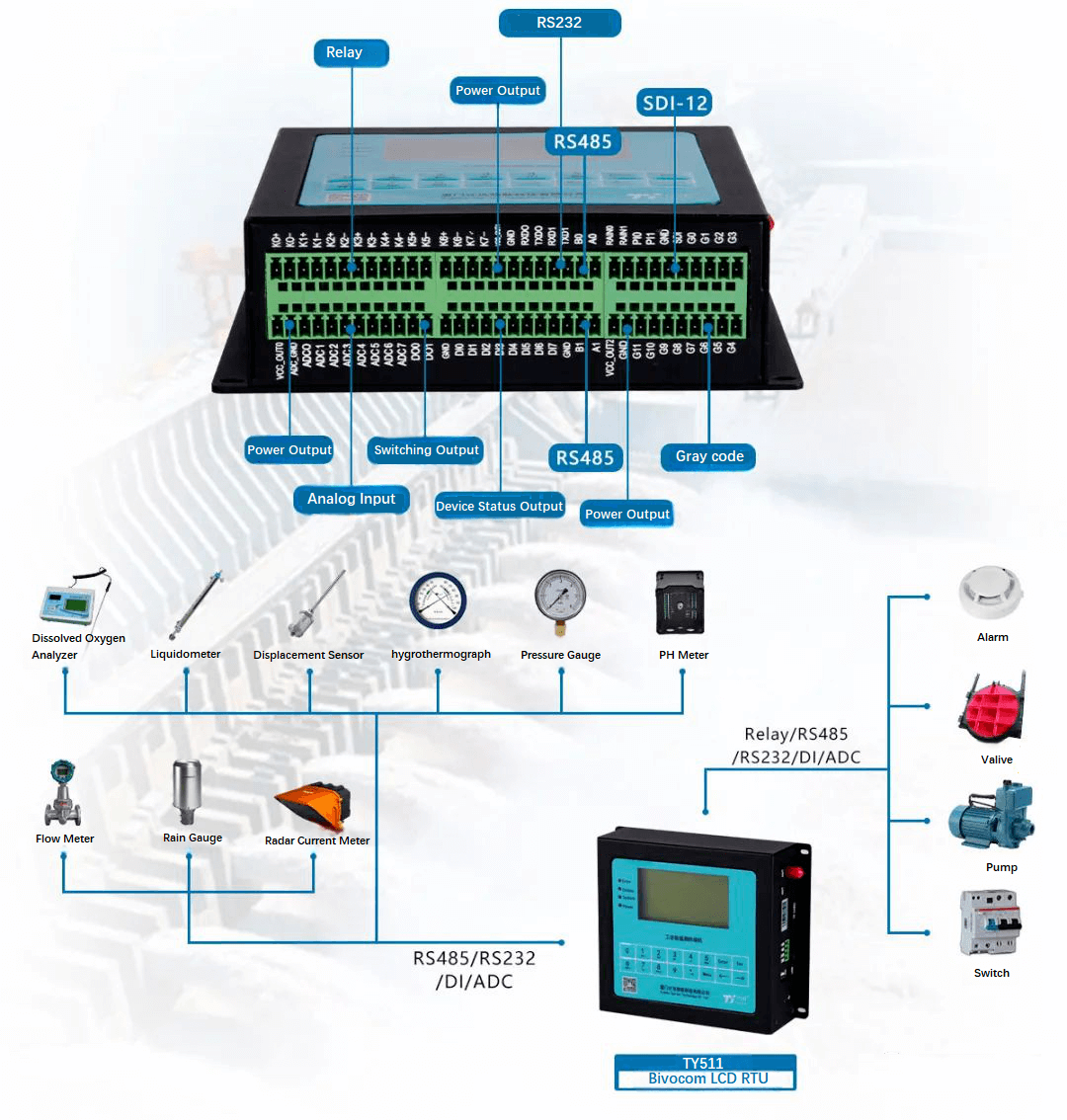
The Bivocom TY511 is an industrial cellular RTU engineered for applications that demand local control autonomy—not just data transmission. It combines rich I/O with onboard logic execution and 16MB local storage, ensuring the system keeps running even when cellular connectivity drops. The integrated LCD display (128×64) enables on-site data viewing and parameter configuration without external tools. Typical use cases include flood control, irrigation management, hydrology monitoring, and environmental SCADA systems where remote equipment must react instantly and autonomously. Key specifications:
- Serial & I/O: 2× RS232, 2× RS485; 8× DI (optical isolation), 8× relay (30VDC/250VAC, 4A max), 8× ADC (16‑bit, 4‑20mA or 0‑5V)
- Specialty & Power: 2× tipping bucket rain gauge (0‑1V), 2× pulse (2‑30V), 2× digital output (Open Collector, 50mA/35V); 3× power outputs (12V, total 2A) for external sensors
- Cellular: 4G LTE CAT 4, 1× SIM, 2× 50Ω SMA
- Storage: 16MB local data storage
- Protocols: Modbus RTU/TCP, MQTT, Transparent, TCP/UDP
- Management: Config Tool, Cloud DMP, SMS alarm
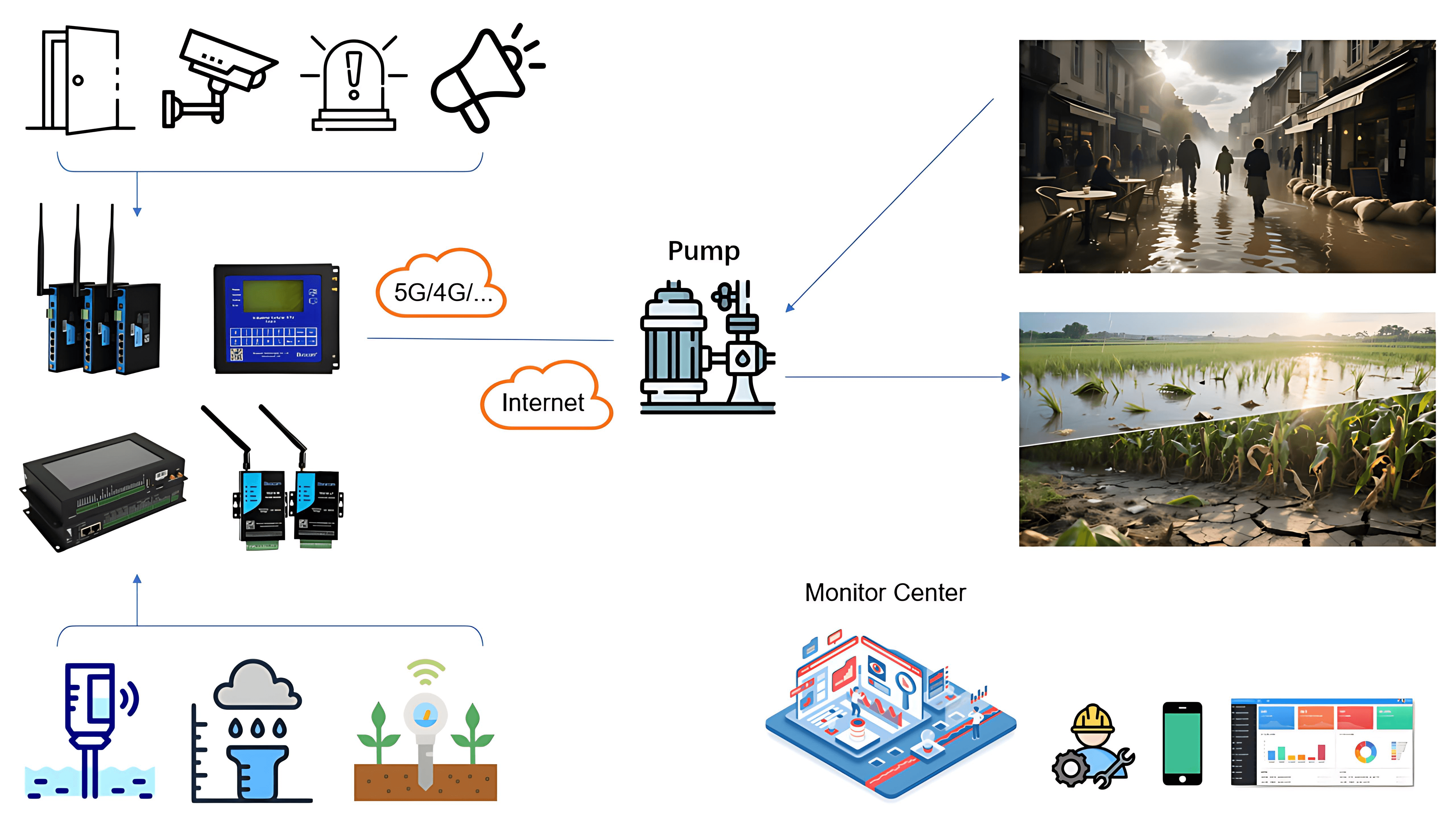
Real World Scenario: Flood & Irrigation Pump Station
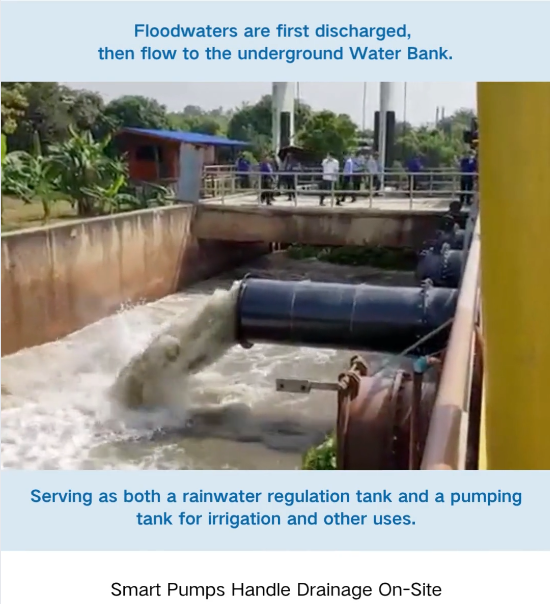
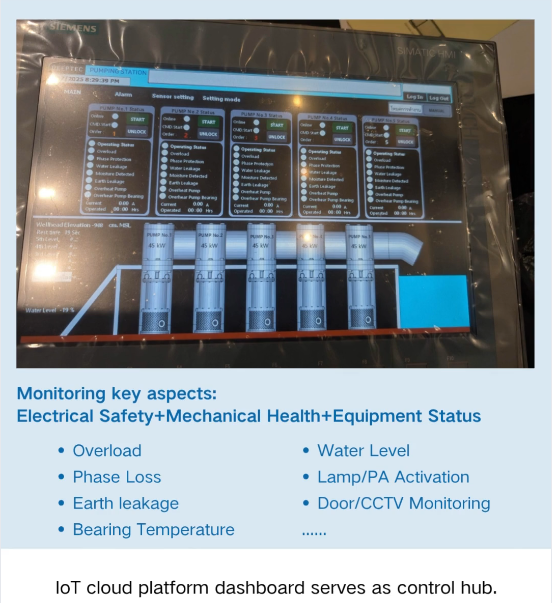
For remote flood prevention and irrigation, the TY511 LCD RTU acquires water level, rain gauge, and soil moisture data, plus auxiliary cabinet statuses (lamp, PA, door, CCTV). It executes autonomous threshold logic, logs events and pump workloads locally (16MB), forwards data to SCADA via 4G, and triggers SMS alerts for breaches—ensuring proactive oversight even during cellular outages.
Final Takeaway
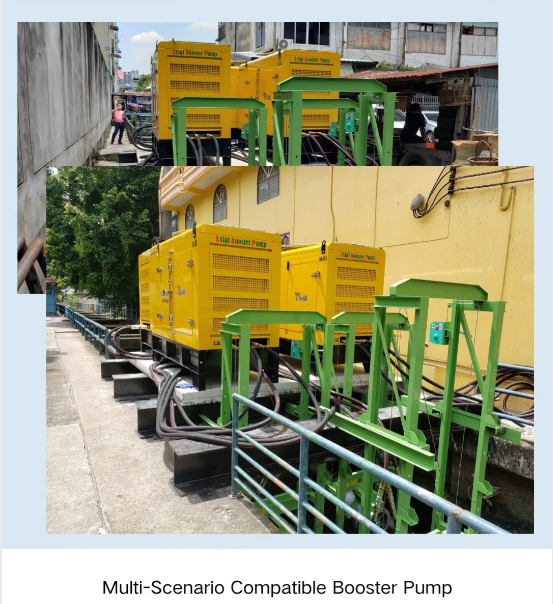
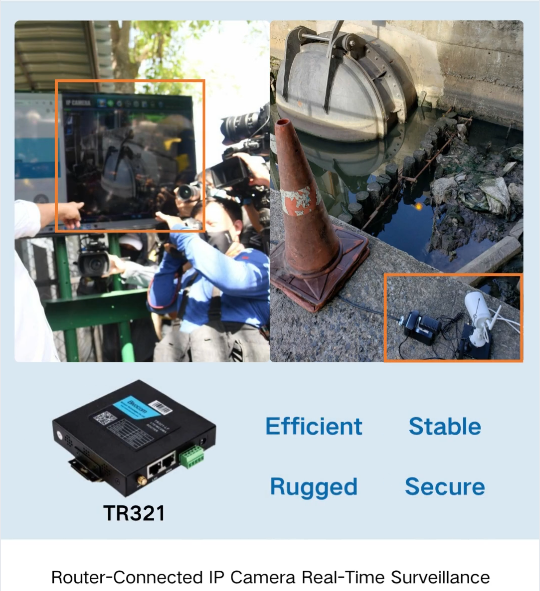
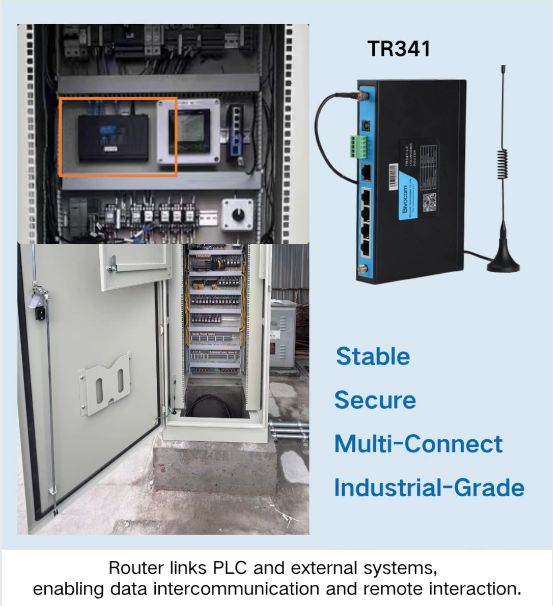
In practice, most IoT deployments use these devices together. A remote pump station, for example, might use a modem to connect a flow meter, a router to share that connection across cameras and a local terminal, a gateway to translate pump data into cloud-friendly MQTT, and an RTU to monitor water levels and control pumps autonomously—even when the network is down. Each has a role, and together they form a complete system.
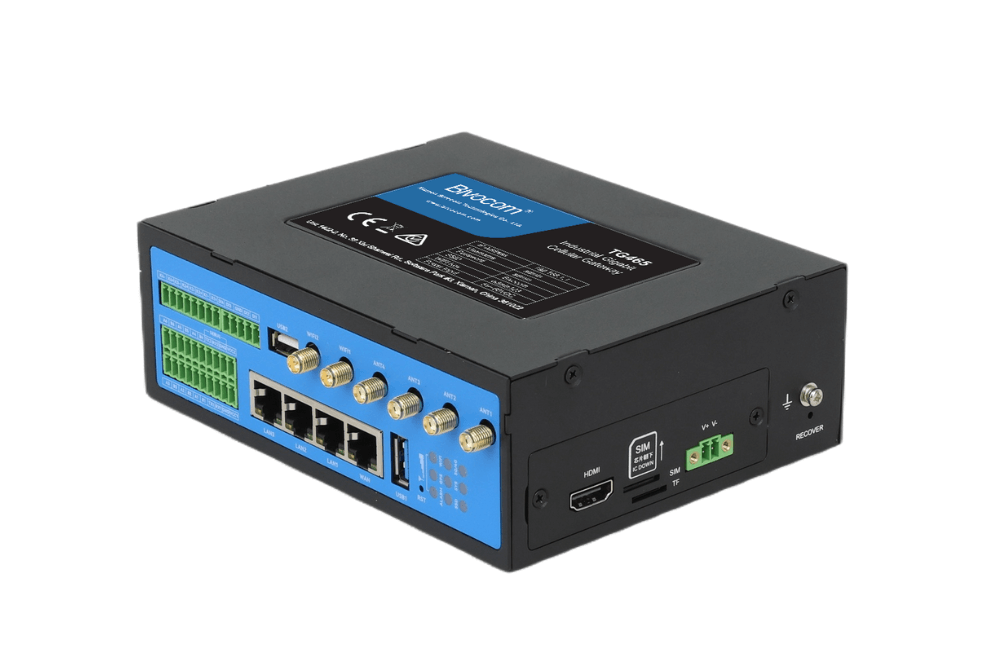
The lines between these categories, however, have blurred significantly. Modern deployments increasingly prefer one box that does multiple jobs over four separate ones. Take Bivocom’s TG465 Programmable 5G Edge Gateway. It’s marketed as a gateway, but it offers:
- Quad-core 64-bit ARM Cortex-A55 up to 2GHz, 1 TOPS NPU, 2GB DDR4, 16GB eMMC
- 4× RJ45(GbE), 1× RS232, 6× RS485, 4× DI, 4× Relay, USB3.0, USB2.0, TF, HDMI(Option), Super capacitor(Option)
- 5G/4G, Wi-Fi 6, GPS, VPN
- MQTT, Modbus RTU/TCP, JSON, OPC UA, DNP3, IEC101/104/61805
- Bivocom OS with Python/C/C++ programmable, or Unbuntu, Openwrt Linux OS, docker container, Node-RED, flexible for secondary development
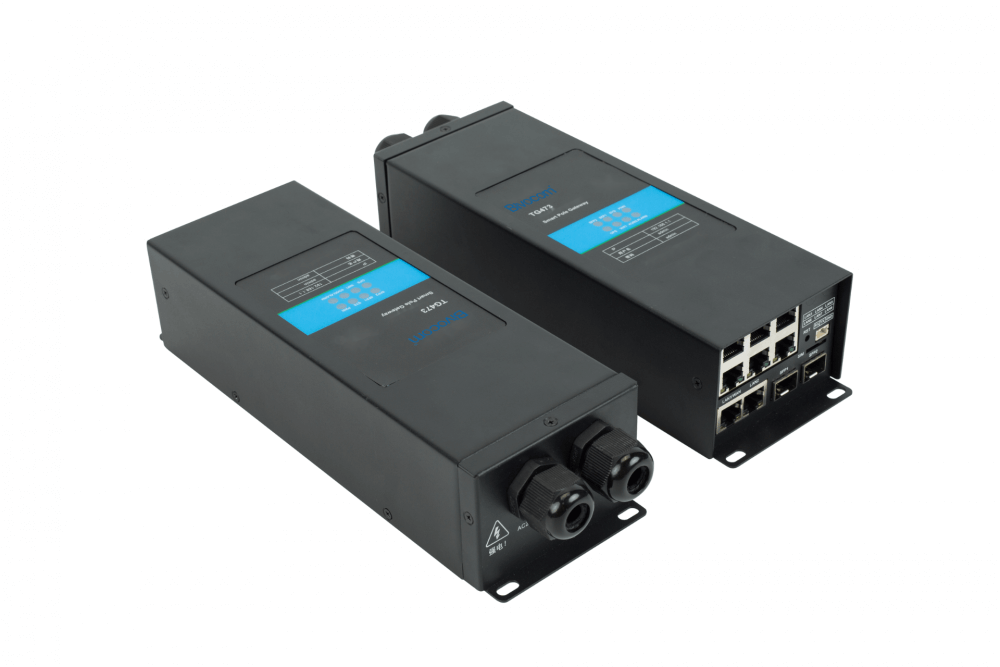
Similarly, the TG473 Lite integrates SFP fiber, Gigabit Ethernet with PoE, RS485, and DI into a single unit—combining routing, switching, and sensor connectivity for smart pole and urban infrastructure deployments.
So how do you choose?
Don’t focus on the label. A “gateway” might have more I/O than some RTUs. A “router” might support protocol translation that rivals a dedicated gateway. Read the interface list. Read the software feature set. Ask yourself: What physical interfaces do I need? What protocols do my devices speak? Do I need local control when the network is down? Do I need edge computing—filtering, aggregation, or analytics at the source? If a device has the I/O you need, the protocols you require, and the processing power your application demands—it doesn’t matter what the box says. What matters is whether it does the job.
Choose the capability, not the category.
About Bivocom
Bivocom is a global provider of industrial IoT and M2M solutions, with over a decade of experience across 90+ countries. Our portfolio covers GNSS/LoRa/5G routers, gateways, and RTUs, IoT platforms, and scenario-specific sensors—plus OEM/ODM customization—serving industries like energy, water utilities, smart cities, automation, and transportation. To make sense of it all, think of it this way:
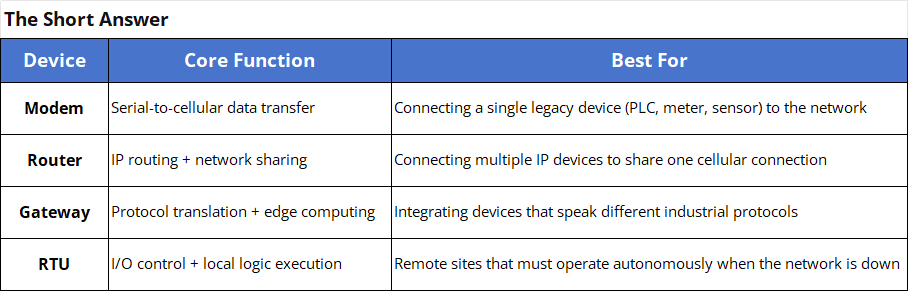
- Need to get one device online? That’s a modem—like a dedicated phone line for that single piece of equipment.
- Need to connect multiple IP devices through one uplink? That’s a router—like a phone switchboard sharing one line across dozens of desks.
- Need to bridge devices that speak different protocols? That’s a gateway—like a translator turning multiple languages into one the cloud understands.
- Need a device that monitors and acts on the spot—even when the network is down? That’s an RTU—like a security guard who watches his post, detects anomalies, and takes action immediately, without waiting for a call from headquarters.
A single Bivocom device can now be a phone line, a switchboard, a translator, and a security guard all at once—depending on what your project needs. That’s the power of modern industrial IoT: one box, many jobs. This article covered gateways and RTUs. Combined with our previous piece on modems and routers, you now have a complete framework for choosing the right device for your IoT deployment. Have questions? Reach us at [email protected].
-on-Bivocom-TG465-IoT-Edge-AI-Gateway-with-Ubuntu-768x512.png "Install Ollama & Llama (LLM, large language model)) on Bivocom TG465 IoT Edge AI Gateway with Ubuntu")
Comment