Global IoT Connectivity Solutions
For years, IoT has been held back by an invisible bottleneck: the physical SIM card. Every smart meter, container tracker, sensor needed its own operator-specific card. Want to deploy across six countries? Manage six different SIM inventories. Need to switch carriers halfway through a device‘s 15-year life? Send a technician to swap the card. Meanwhile, eSIM has evolved into a remotely programmable connectivity solution that breaks hardware limits—activating anywhere, switching operators at will, all from a cloud dashboard without physical device access. For Bivocom, optimizing eSIM IoT connectivity also helps simplify cross-border device deployment and reduce long-term operation costs.
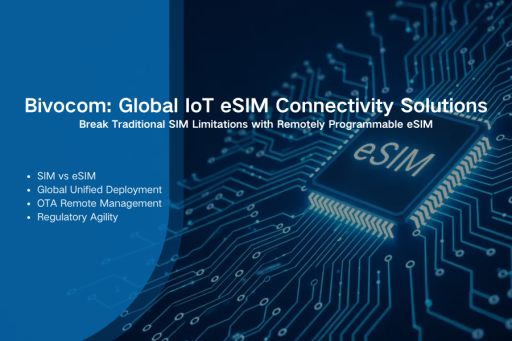
Limitations of Traditional SIM in IoT
Traditional physical SIM cards present inherent drawbacks that hinder large-scale and global IoT deployment, with key challenges outlined below:
- Hardware vulnerability: Pluggable design suffer from poor contact, oxidation, and failure under vibration, moisture, and extreme temperatures in industrial environments.
- Sealing & protection: SIM card slots compromise device enclosures, making it difficult to achieve or maintain IP67/IP68 ratings for outdoor industrial equipment.
- Complexity at scale: Global IoT rollouts span millions of devices across continents, each requiring its own carrier contract and a physical SIM card.
- Operational drag: On-site manual replacement and routine maintenance drive massive labor and logistics costs, while regional SIM procurement and deployment further delay global product timelines.
- Physical inaccessibility barriers: Many IoT devices operate underground, on moving vehicles, or inside sealed enclosures where physical SIM swaps are impossible.
- Regulatory fragmentation: Countries that ban permanent roaming require devices to switch to a local carrier after a set period—a fixed physical SIM cannot meet this requirement.

What Is eSIM ?
An eSIM (embedded SIM) is a hardware‑based eUICC (Embedded Universal Integrated Circuit Card) soldered directly onto an IoT device’s printed circuit board. Unlike a removable plastic SIM that holds a single, fixed operator credential for its entire lifetime, an eSIM securely stores multiple operator profiles and can switch between them over the air (OTA) – fully managed via cloud platforms without any physical access to field‑deployed devices. This makes eSIM the foundational connectivity enabler for large‑scale, cross‑border, and unattended IoT implementations. The technology complies with GSMA global standards spanning legacy M2M (SGP.01/SGP.02), consumer‑grade deployment for smartphones and tablets (SGP.22), and the latest IoT‑optimized specifications (SGP.31/SGP.32).
Core Capabilities & Value
- Supports storage and seamless switching of multiple operator profiles.
- Enables one-click global activation and cross-region carrier roaming compliance.
- Adapts to regulatory requirements of regional local carrier replacement to avoid permanent roaming restrictions.
- Integrates seamlessly with IP67/IP68 industrial enclosure design without reserved SIM slots.
Core Technical Architecture
Industrial eSIM operates on a three-layer standardized ecosystem, consisting of hardware chips, embedded assistant components, and cloud remote management platforms:
1. eUICC Secure Chip: The core hardware carrier, pre-programmed with a globally unique EID for identity recognition. It securely stores multiple operator network profiles, encryption keys and authentication credentials with hardware-level tamper-proof protection.
- IPAe (Embedded IPA) – Runs natively inside the eUICC chip, ideal for low-power, resource-limited devices such as sensors and smart meters, requiring no extra development on the device side.
- IPAd (Device-hosted IPA) – Deployed on the main processor of high-performance IoT devices like industrial gateways, supporting complex policy-based network switching.
3. Cloud Remote Management System:
- SM‑DP+ (Subscription Manager Data Preparation+) – Prepares, encrypts, and delivers signed operator profiles.
- SM‑DS (Subscription Manager Discovery Server) – Helps the device locate pending profile download events.
- eIM (eSIM IoT Remote Manager) – An orchestration layer introduced by SGP.31/32. The eIM can trigger profile downloads, schedule switches, and manage fleets of devices even when they are offline or in deep sleep.
4. Authentication & Security Mechanism – Security and authentication are the foundational pillars of industrial eSIM, adopting a dual-certification system:
- RSP Provisioning Authentication – Establishes mutual TLS encryption between eUICC and cloud servers via GSMA root CA certificate chains, verifying the legitimacy of both the device chip and network management platform to prevent middle-man attacks.
- Cellular Network Access Authentication – Leverages 3GPP AKA algorithm and built-in Ki keys to complete challenge-response verification with carrier core networks, realizing secure device access and encrypted data transmission.
The core function is identical to a traditional SIM: authenticating a device onto a cellular network. But everything else — how it is installed, managed, switched, and secured — is fundamentally different.
 "Bivocom eSIM -- Architecture Diagram with IPA in the IoT Device")
eSIM in Action: Where & Why It Works
Industrial IoT Typical Deployment Scenarios
The combination of remote programmability and rugged hardware makes eSIM suitable for deployments that were previously impossible or uneconomical:
- Smart meters: electricity, gas, and water metering systems.
- EV charging infrastructure: public and private charging stations.
- Logistics trackers: global fleet and container tracking.
- Industrial automation: factory monitoring and industrial control systems.
- Renewable energy systems: solar PV and distributed energy assets.
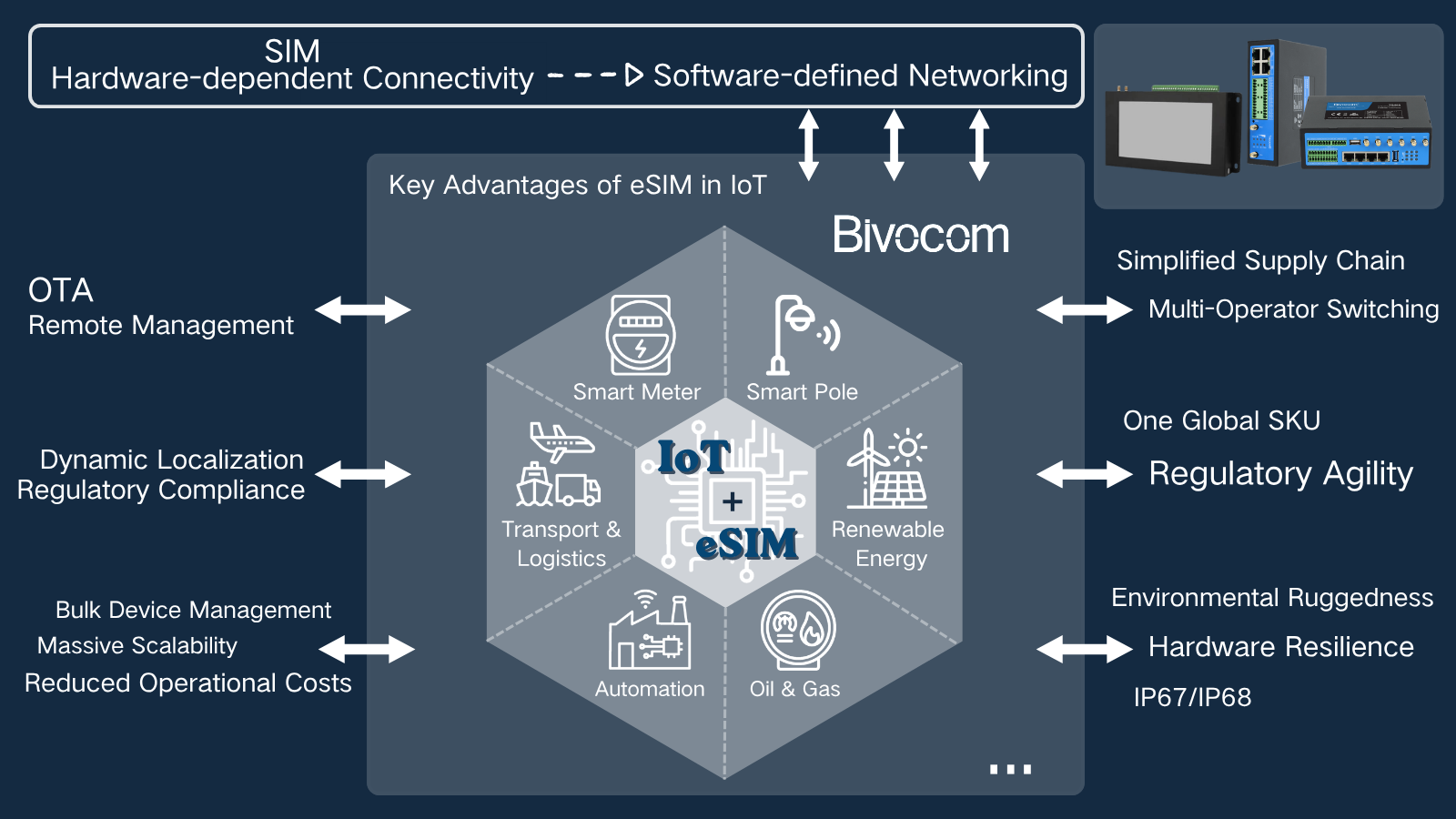
Key Advantages of eSIM in IoT
Traditional SIM cards lock devices into a single operator. Industrial eSIM removes that lock. The table below distills the five most impactful advantages for real‑world IoT fleets.
- One global hardware SKU: Manufacture the same device for all markets. Activate the right local profile after deployment — no more regional inventory fragmentation nor per‑country SIM sourcing.
- Zero truck rolls: Switch carriers, update connectivity policies, or troubleshoot coverage remotely. Even for devices on rooftops, inside cargo containers, or buried underground.
- Regulatory agility: Slightly higher bill‑of‑materials (BOM) cost per unit. Massive savings in logistics, inventory management, field operations, and long‑term maintenance.
- Environmental & physical resilience: No SIM slot means no corrosion, no contact failure, no vibration loosening. Achieving IP67/IP68 becomes trivial — essential for outdoor industrial equipment.
Industry research confirms the shift. Juniper Research forecasts that connected logistics, oil & gas monitoring, and smart street lighting will be the fastest‑growing eSIM IoT sectors in 2026. These three verticals alone are expected to contribute 75 million new eSIM connections this year.
Evolution & Future of eSIM in IoT
The global IoT landscape is steadily shifting from hardware-dependent connectivity to software-defined networking, and eSIM stands at the center of this transformation. eSIM technology is maturing fast. The shift from older M2M standards (SGP.02) to the current IoT‑optimized SGP.32 marks a major leap: IP‑based transport, true multi‑operator independence, and zero‑touch management. Looking forward, two trends will shape the next phase: iSIM (Integrated SIM): The eSIM function moves directly into the device’s main processor or modem. IFPP (SGP.41/42): Operator profiles are loaded during manufacturing, not after deployment.
About Bivocom
Industrial IoT deployments no longer need physical SIM constraints, on-site maintenance, or cross‑border barriers. Today, every Bivocom device — LoRA/4G/5G routers, gateways, modems, and RTUs — fully supports industrial‑grade eSIM. We enable multi‑carrier switching, over‑the‑air provisioning, and IP67/IP68 sealed enclosures. Bivocom turns complex global connectivity into simple, cost‑efficient, and remotely manageable assets.
- Zero-Touch Remote Operation: Support full OTA eSIM provisioning and carrier switching to cut on-site maintenance and operational costs.
- Reliable Connectivity: Deliver industrial-grade eSIM networking adapted for harsh environments and long-term unmanned field operations.
- Technical Support: From factory provisioning to field troubleshooting, we ensure your eSIM rollout succeeds at scale.
Ready to Upgrade Your IoT Deployment with eSIM?
What’s next? In our upcoming article, we will walk you through exactly how a Bivocom eSIM gateway works. Reach out to Bivocom today at [email protected] — we’re here to help you deploy scalable, compliant and cost-effective eSIM IoT solutions.
-on-Bivocom-TG465-IoT-Edge-AI-Gateway-with-Ubuntu-768x512.png "Install Ollama & Llama (LLM, large language model)) on Bivocom TG465 IoT Edge AI Gateway with Ubuntu")



1 Comment